
Beneath Paris, the Dead Are Still Waiting
Paris is known as the City of Light. It is known for romance, cafés, art, fashion, and streets that feel almost too beautiful to be real.
But beneath all of that beauty sits something much darker.
Roughly twenty meters below the streets of Paris is a maze of tunnels, stone passageways, and walls made from human remains. The Paris Catacombs hold the bones of millions of people, stacked, arranged, and displayed in one of the most haunting underground sites in the world.
Today, the Catacombs are a historic attraction, a museum, a memorial, and, depending on who you ask, one of the most haunted places in Paris.
But the story of the Paris Catacombs does not begin with ghosts.
It begins with a city running out of room for its dead.
Paris Before the Catacombs
To understand the Paris Catacombs, we have to start with the city above them.
Paris in the 1700s was not the clean, romantic city many people imagine today. It was crowded, loud, dirty, and still medieval in many places. The grand boulevards and carefully planned streets would not fully arrive until the 19th century, when Baron Haussmann reshaped the city.
Before that, Paris had narrow streets, packed homes, poor sanitation, and cemeteries that had been used for centuries.
And those cemeteries were becoming a serious problem.
For generations, Parisians buried their dead inside the city, often close to churches and parish communities. When Paris was smaller, this made sense. But as the city grew, the burial grounds filled up. Then they overfilled. Then they became a public health nightmare.
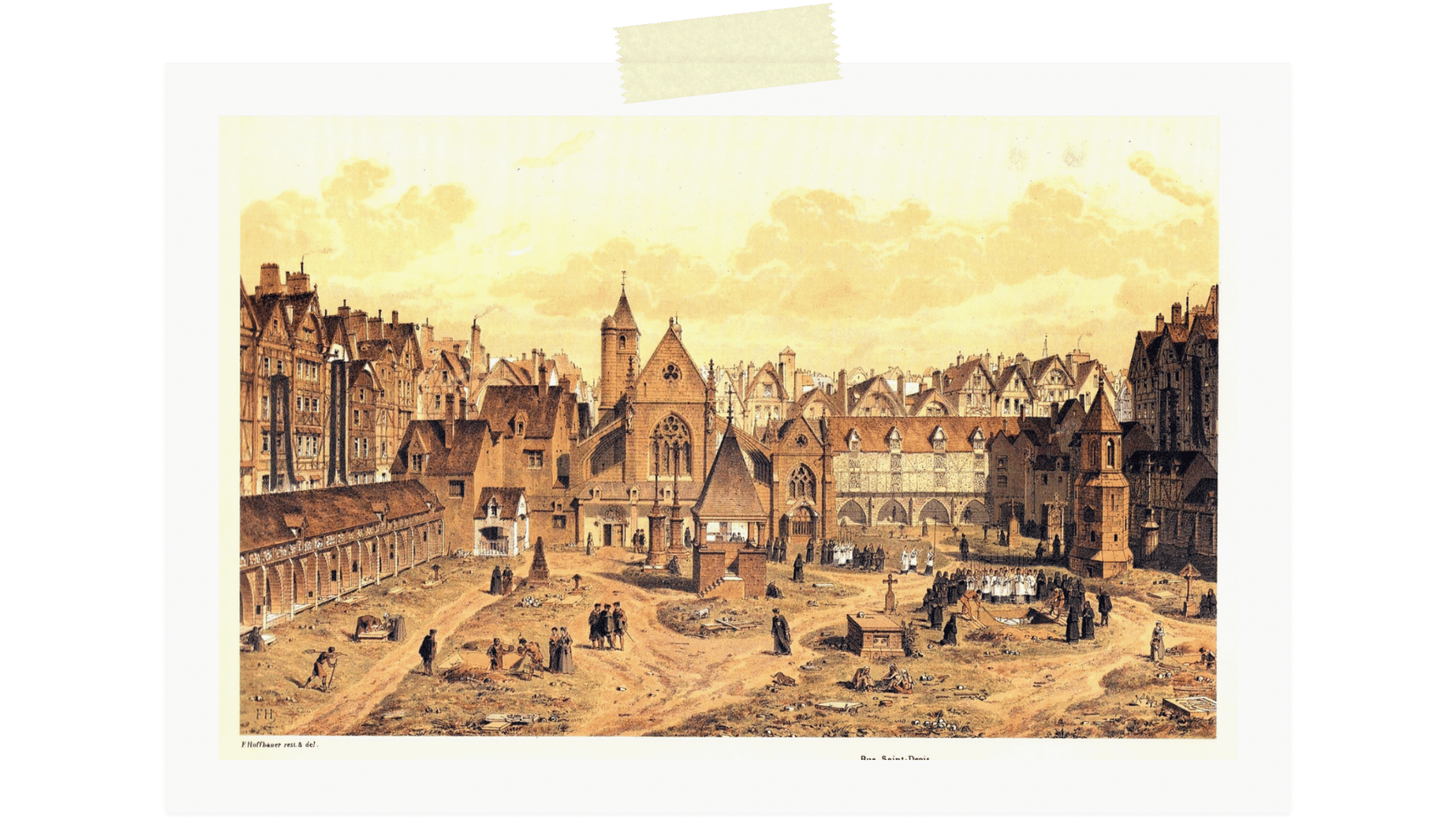
The most infamous cemetery was the Cemetery of Saints-Innocents, also known as Les Innocents. Located near Les Halles, the city’s central market district, it received the bodies of ordinary Parisians, the poor, plague victims, and countless anonymous dead.
Over time, the cemetery became so overcrowded that bodies were not always buried individually. Many were placed in mass graves. When one layer filled, another was added. Then another. Then another.
By the late 1700s, the dead were no longer staying politely underground.
In 1780, a wall bordering the Saints-Innocents cemetery collapsed, spilling human remains into nearby property. It was horrifying, but it was also a warning. Paris had too many dead bodies, not enough cemetery space, and growing fears that the city’s burial grounds were contaminating the living.
The city needed a solution.
Strangely enough, that solution was already beneath their feet.
The City Built From Its Own Bones
Before the Paris Catacombs became an ossuary, they were quarries.
Paris sits on layers of limestone, including the famous Lutetian limestone used to build parts of the city itself. Long before the tunnels held human remains, workers dug stone from beneath and around Paris to construct the city above.
In other words, before the Catacombs held the dead of Paris, they helped build the Paris of the living.
Quarrying in the area began very early, with open-pit quarries dating back to ancient times and underground quarrying expanding by the Middle Ages. Workers cut passageways and chambers beneath the city, removing stone block by block.
Over centuries, this created an underground version of Paris. A shadow city. A negative image of the one above.
But these old quarry tunnels were not always carefully mapped or maintained. As Paris grew above them, the empty spaces below became dangerous.
Then came the collapses.
In 1774, a serious collapse occurred near Rue Denfert-Rochereau. Other sinkholes and subsidence issues followed. Paris was quite literally standing over empty space.
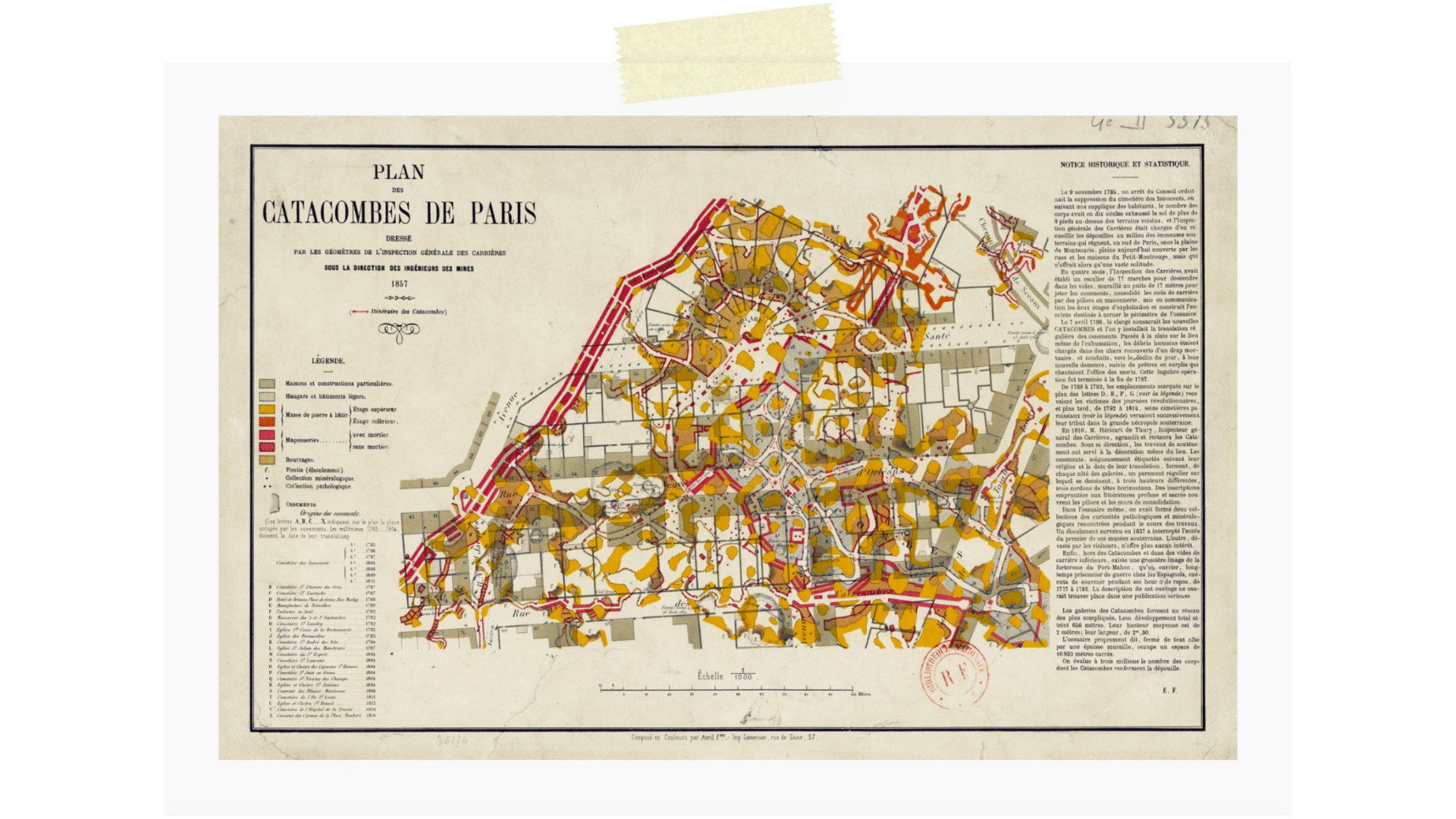
King Louis XVI responded by banning quarrying under public roads in 1776. In 1777, he created the Department of General Quarry Inspection, also known as the Inspection Générale des Carrières, to inspect, map, and reinforce the tunnels.
So by the 1780s, Paris had two major problems.
Above ground, the cemeteries were overflowing.
Below ground, the abandoned quarries needed stabilization and purpose.
The city needed to move the dead.
The quarries needed a use.
And that is how Paris arrived at one of the most practical and macabre solutions in history: move the bones into the abandoned tunnels.
Building the Paris Catacombs
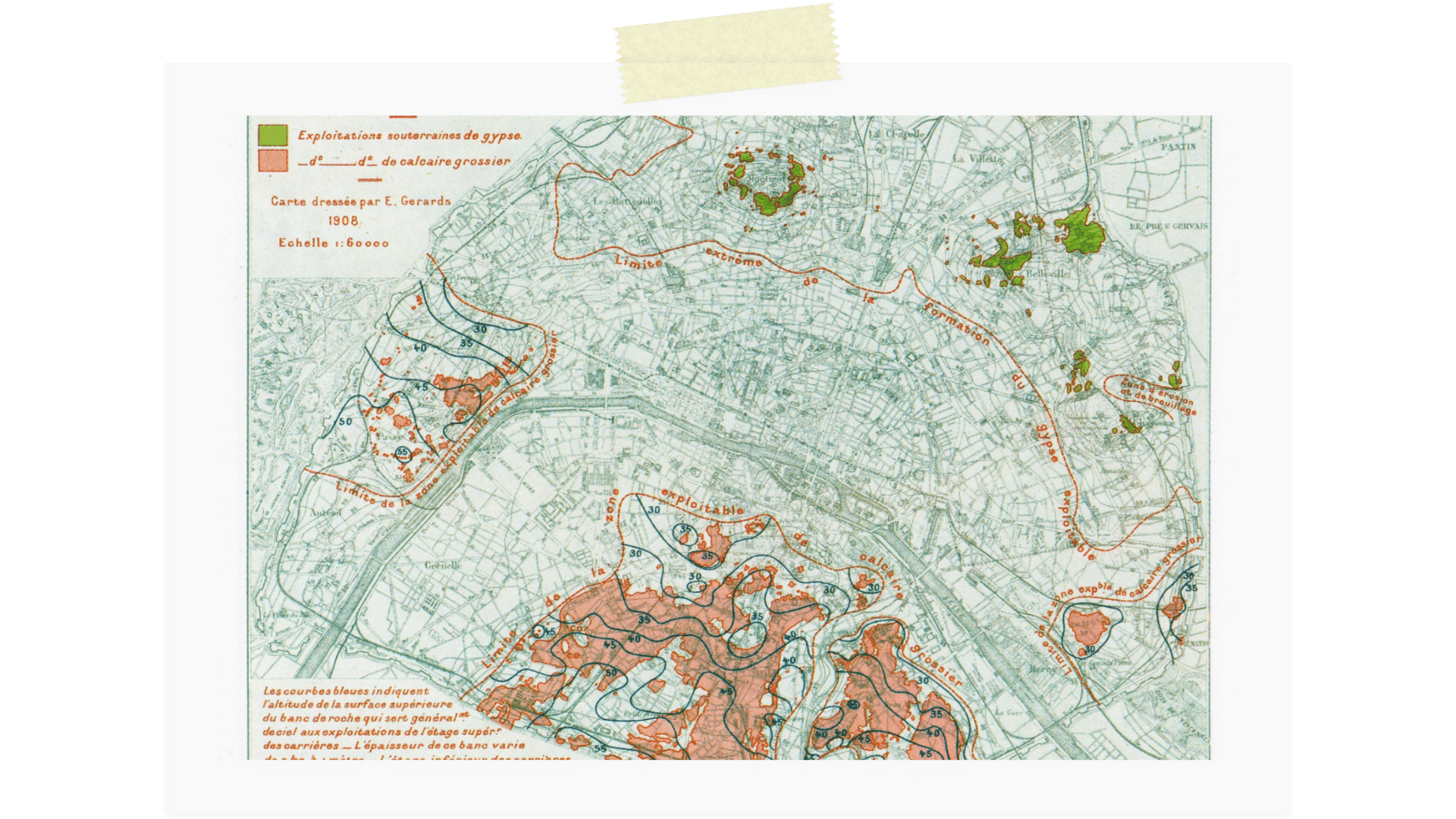
The site chosen for the ossuary was the former Tombe-Issoire quarries near what is now Place Denfert-Rochereau. At the time, this area was outside the dense center of Paris, making it a logical place to receive remains from the city’s overcrowded cemeteries.
On April 7, 1786, the Tombe-Issoire quarries were blessed and consecrated as a municipal ossuary. This marked the official beginning of what became known as the Paris Catacombs.
Technically, the Paris Catacombs are not catacombs in the original ancient Roman sense. They are an ossuary, meaning a place where bones are stored. But the name “catacombs” stuck, partly because it evoked the ancient underground burial networks of Rome.
The transfer of bones began in 1786.
The work was grim, slow, and deeply strange.
Remains were exhumed from Parisian cemeteries, loaded onto carts, covered, and transported through the city, often at night. Workers moved the bones into the quarry system, where they were initially deposited in large piles.
The carefully arranged skull walls that visitors see today came later.
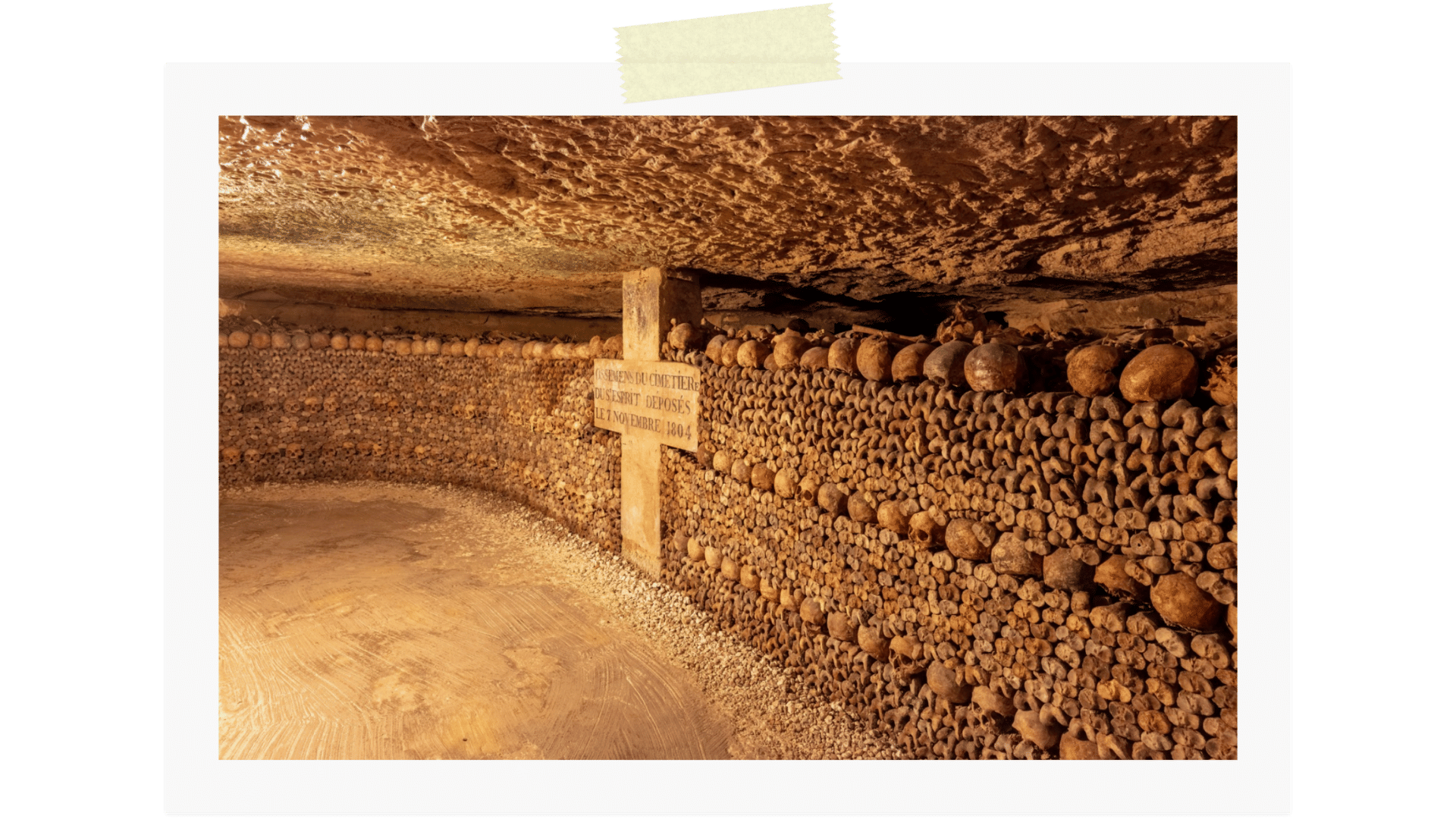
In the early 19th century, Inspector General Louis-Étienne Héricart de Thury helped transform the ossuary into something more deliberate. Bones were stacked into walls. Skulls were arranged in patterns. Inscriptions were added. The site became not only a storage place for the dead, but a place meant to make visitors reflect on mortality.
Somewhere along the way, a mass bone repository became a monument.
A sermon in skulls.
A museum of death.
How Many Bodies Are in the Paris Catacombs?
The Paris Catacombs are commonly said to contain the remains of around six million people.
That number is difficult to fully confirm because many remains were transferred from mass graves, mixed together, and separated from their original burial places. But the scale is almost impossible to comprehend.
Six million is not just a cemetery.
Six million is a vanished city.
The bones came from multiple Parisian burial grounds, including Saints-Innocents and other parish cemeteries. Because the remains were moved in mass, most individuals cannot be identified.
This leads to one of the most common questions people ask:
Are any famous people buried in the Paris Catacombs?
The answer is complicated.
Because so many Parisian cemeteries were emptied into the Catacombs, it is possible that the remains of historically significant people ended up there. Some popular sources associate the Catacombs with famous French figures, but in most cases, the bones were mixed and cannot be individually confirmed.
The truth may be even more powerful.
The Paris Catacombs are not frightening because they hold one famous king, murderer, saint, or noblewoman.
They are frightening because they hold ordinary people.
Bakers. Mothers. Children. Soldiers. Priests. Beggars. Merchants. People who lived full lives, had bad days, told jokes, owed money, fell in love, and vanished into time.
Now, their bones line the walls beneath Paris.
The Paris Catacombs Today
Today, the Paris Catacombs are managed as a historic site and museum. The official visitor route is only a small portion of the much larger underground network.
Visitors descend more than a hundred steps, walk through dim tunnels, pass through the ossuary, and eventually climb back up into modern Paris. The official route is controlled, but the larger underground quarry network remains mostly off-limits.
That has not stopped urban explorers.
Known as cataphiles, some explorers illegally enter restricted sections of the tunnels. These areas can be dangerous, unstable, flooded, confusing, and extremely easy to get lost in. The underground network has developed its own mythology, subculture, and stories of secret rooms, hidden parties, forbidden passages, and strange discoveries.
In recent years, the Catacombs have also been studied as a scientific archive. Researchers have examined bones to better understand disease, injury, diet, and life in earlier centuries.
That is one of the strangest things about the Paris Catacombs. They are a tourist attraction. They are a memorial. They are an engineering solution. They are a scientific resource. They are an illegal explorer’s dream and, according to legend, they may also be haunted.
Are the Paris Catacombs Haunted?
The history of the Paris Catacombs is well documented.
The hauntings are different.
Stories of ghosts, voices, footsteps, shadowy figures, and lost souls come from legends, urban explorer accounts, paranormal retellings, online folklore, and visitor experiences. Some are attached to real historical events. Others are modern stories that have grown in the darker corners of the internet.
That does not mean the stories are not worth exploring.
It just means they should be treated as legends and claims rather than proven fact.
And with a place like the Paris Catacombs, the legends almost write themselves.
Philibert Aspairt: The Lost Man of the Catacombs
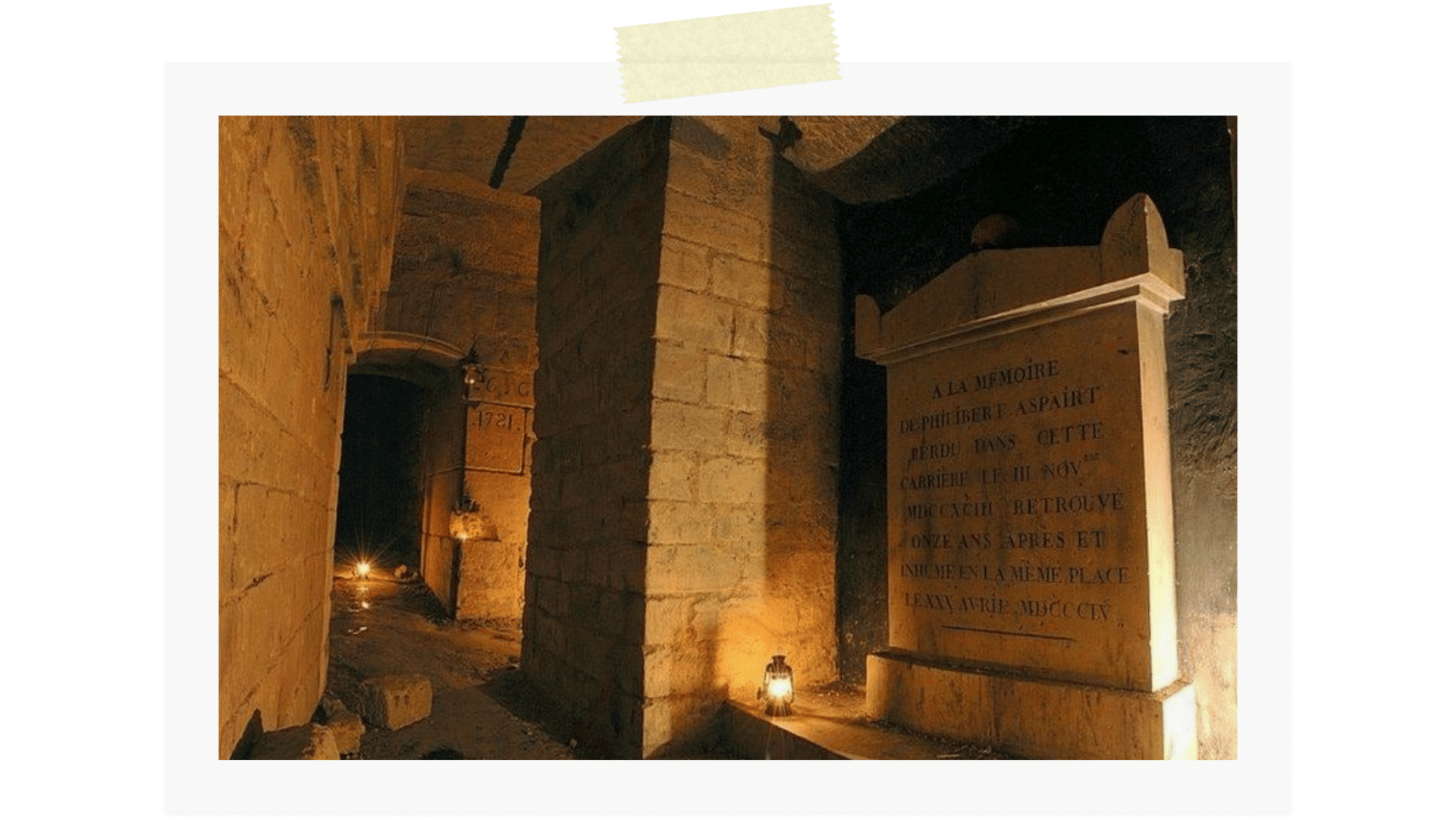
The most famous ghost story connected to the Paris Catacombs is the story of Philibert Aspairt.
Aspairt was a real person, although some details of his story vary. He is usually described as a doorkeeper or porter at the Val-de-Grâce hospital during the French Revolution.
In 1793, Aspairt entered the underground quarry system. Why he went down there is uncertain. Some versions of the story claim he was looking for liquor stored in a cellar. Other versions are more cautious and say his motive is unknown.
What is known is that he disappeared.
His body was reportedly found eleven years later, in 1804, deep within the quarry galleries. He was buried near the place where he was found, and a marker commemorates his death.
The real story is already terrifying.
No monster. No curse. No glowing-eyed demon skulking between the bones.
Just a man underground with a failing light.
Imagine realizing you are lost down there. At first, maybe it is only frustrating. You turn left, then right, then left again. The tunnel looks familiar, but every tunnel looks familiar. Your candle burns lower. The air is cold. There is no sunlight. No street noise. No bells. No horses. No voices.
Then the light goes out.
That darkness is not normal darkness. It is absolute. It swallows distance. It turns every sound into a threat.
Over time, Aspairt became more than a tragic historical figure. In Catacombs folklore, he became a ghost. Some say his spirit wanders the tunnels on the anniversary of his disappearance. Others describe him as a kind of patron saint of the lost, still searching through the underground maze.
There is no proof that Philibert Aspairt haunts the Paris Catacombs.
But as a ghost story, it works because the real story is already enough.
He entered the dark and never came back.
Voices, Footsteps, and the Feeling of Being Followed
Many reported hauntings in the Paris Catacombs follow a familiar pattern.
Visitors and explorers claim to hear footsteps behind them, whispers from empty corridors, voices in the distance, scraping sounds, breathing, or echoes that do not seem to belong to anyone nearby.
These stories are difficult to verify, but the environment itself makes them easy to understand.
The tunnels are narrow. The walls are stone. Sound travels strangely underground. A voice from one passage can seem to come from another. Footsteps can echo, split, return, and make one person sound like several.
The Catacombs also create a kind of sensory pressure.
There is no daylight. Normal city sounds disappear. The temperature drops. The air changes. The architecture repeats itself over and over. The brain starts searching for patterns.
A drip becomes a signal. A shadow becomes a figure. A pause in conversation becomes a presence.
That does not mean every experience is fake. It means the Paris Catacombs are almost perfectly designed to make human perception unreliable.
And that may be one reason the ghost stories thrive.
The Found Footage Legend
One of the most famous modern legends connected to the Paris Catacombs is the so-called missing man footage.
The story usually goes like this: sometime in the 1990s, a video camera was allegedly found deep in the Catacombs. The footage supposedly shows a man wandering through the tunnels, becoming more and more panicked. He breathes heavily. He moves faster. Eventually, he drops the camera and disappears into the darkness.
According to the legend, the man was never found.
It is an incredibly effective story because it taps into a real fear.
Getting lost in the Catacombs is not impossible. The official visitor route is safe and controlled, but the restricted tunnel network is dangerous, confusing, and illegal to enter. A maze beneath Paris is scary enough without adding ghosts.
The found footage story should be treated as an urban legend, not a confirmed missing-person case. Still, it has become part of the Catacombs’ modern folklore.
Because sometimes the scariest thing underground is not a ghost.
Sometimes it is the maze.
https://www.reddit.com/r/nope/comments/16ujoh1/paris_catacombs_found_footage/ Link to the reddit post containing the footage!
Secret Rituals, Hidden Rooms, and Underground Legends
The Paris Catacombs have also been linked to stories of secret rituals, occult meetings, underground parties, hidden cinemas, black masses, and secret societies.
Some of these stories are likely exaggerated. Others may be rooted in real unauthorized activity. The larger tunnel network has attracted explorers, artists, thrill seekers, criminals, and partygoers for decades.
That kind of place naturally breeds rumors.
A massive underground network filled with bones, graffiti, illegal entrances, hidden chambers, and restricted passages is basically a folklore machine. Normal rules feel suspended down there. Above ground, Paris is elegant, regulated, and visible. Below ground, the city becomes something older and stranger.
The Catacombs are not only haunted by the dead.
They are haunted by secrecy.
Why Do People Think the Paris Catacombs Are Haunted?
There are several reasons the Paris Catacombs have become one of the most haunted places in Paris.
The first reason is obvious: death.
The Catacombs contain the remains of millions of people. For paranormal believers, places connected to death, grief, and human remains can hold spiritual energy. If battlefields, hospitals, and cemeteries can be haunted, then an underground ossuary filled with millions of bones feels like a supernatural lightning rod.
The second theory is displacement.
The dead in the Catacombs were not originally buried there. Their remains were removed from cemeteries, transported through the city, mixed together, and arranged underground. Some believe this disruption could create unrest.
The third theory is emotional residue.
Even from a skeptical perspective, the Catacombs carry enormous emotional weight. They represent plague, poverty, overcrowding, public health panic, revolution, urban growth, and centuries of ordinary people being swallowed by history.
The fourth theory is environmental.
Darkness, cold air, humidity, echoes, narrow passages, uneven floors, and repetitive tunnels can all create anxiety and disorientation. Underground spaces can make people feel trapped, watched, and vulnerable.
The fifth theory is expectation.
People enter the Paris Catacombs already knowing the stories. They have seen videos, read ghost accounts, heard about Philibert Aspairt, and imagined the skull-lined walls. By the time they step underground, the haunting has already started in their minds.
A strange noise in a grocery store is nothing.
A strange noise beneath Paris, surrounded by millions of dead people, becomes a ghost.
The Paris Catacombs: History, Horror, and the Weight of the Dead
The Paris Catacombs began as a solution.
They were created because Paris had a problem with overflowing cemeteries, unstable quarries, and a city growing faster than its burial grounds could handle, but over time, that solution became something else.
It became an underground monument.
A museum of mortality. A city beneath a city.
A place where millions of anonymous dead rest in carefully arranged walls while the living walk by, whisper, take pictures, and wonder what might be whispering back.
Historically, the Paris Catacombs are one of the most fascinating sites in Paris. Spiritually, they are harder to define. They sit somewhere between graveyard and gallery, engineering project and ritual space, memorial and spectacle.
And the ghost stories, whether true or not, make sense.
Of course people imagine footsteps down there. Of course Philibert Aspairt became a legend. Of course the internet created stories of cursed footage and missing explorers. Of course people look into those tunnels and think something is still waiting.
The Paris Catacombs are not scary only because they contain the dead.
They are scary because they remind us that every beautiful city is built over something. Every street has a shadow. Every place of light has a darkness beneath it and under Paris, that darkness is stacked in bones.
https://www.catacombes.paris.fr/en - The official Paris Catacombs website.
About This Episode
This blog post is adapted from our Season 2 episode of the Mystery Date Podcast — “The Paris Catacombs | Into the Empire of the Dead”, part of our A Haunting season exploring the strange and mysterious side of the paranormal.
🎧 Listen to the full episode: Mystery Date Podcast
👕 Grab themed merch: Mystery and Co.
📬 Send us your local legends: mysterydatepodcast@gmail.com | (216) 770-4881