
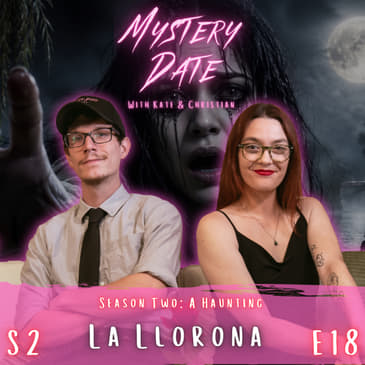
In this episode of Mystery Date Podcast, Christian and Kate dive into the chilling legend of La Llorona, also known as The Weeping Woman. For generations, the story of La Llorona has haunted rivers, lakes, and quiet roads across Mexico, Latin America, and beyond.
She is said to wander near the water, crying for the children she lost, warning anyone who hears her sorrowful wails to run.But where did the legend of La Llorona come from? Is she simply a cautionary tale meant to keep children away from dangerous waters, or is there something older hiding beneath the folklore? This week, we explore the history, cultural roots, ghost stories, and modern sightings connected to one of the most famous urban legends in the world.
From Mexican folklore and colonial-era influences to eerie personal accounts and the lasting impact of the Weeping Woman, this episode looks at why La Llorona continues to terrify people centuries later.
Join us for a haunting date night as we follow the cries of La Llorona into the dark.
💌 Got a mystery or spooky story to share? We want to hear from you!
Send your tales, tips, or local legends to us at mysterydatepodcast@gmail.com orcall the mystery hotline at (216) 770-4881. You just might hear your story on a future episode!
Follow Us for Updates & Behind-the-Scenes Chaos:
Website: https://www.mysterydatepodcast.com
Instagram: /mysterydatepodcast
TikTok: /mysterydatepodcast
Shop: www.mysteryandco.com
Sources & Further Reading: Curious minds welcome!
For a full list of sources, extras, and reading recommendations related to this episode, check out the episode blog on our website.
Production:
Mystery Date is written, edited, filmed, and produced by Christian Sullivan and Kate Sullivan. Music and sound are provided by Descript stock media and Artlist Media. We do not own the rights to any of the images shared in our episodes. All images in this video were sourced from Wiki Commons.
[00:00:00] She is a woman in a tattered white gown, her face either hidden by a veil or transformed into a skeletal mask. Legend says she is Maria, a woman who, in a fit of blind rage and heartbreak, drowned her own children in a river, and is now cursed to wander the earth for eternity searching for them.
[00:00:24] But, is La Llorona merely a campfire story used to keep children away from dangerous waters? Or is she a lingering echo of a much older, darker history involving the fall of empires and the gods of the Aztecs? Tonight, we're diving into the cold currents of the most famous ghost story in the Americas, the haunting tale of La Llorona. I'm Christian. I'm Kate.
[00:00:53] Welcome to Mystery Date. It's Date Night Meeting, we get to talk about all things mysterious and weird. This season is called A Haunting, and it involves all paranormal and ghostly mysteries in our world. Tonight's mystery is all about La Llorona.
[00:01:22] Get comfy, grab your favorite drink, and let's start the show. Sticking with our juice. Yummy, refreshing. Yes, keeping it simple. Got some cranberry apple today. Yeah, it's got lots of hard words to pronounce, so I can't be getting tipsy. And just a little disclaimer up at the beginning. It might be a little rough in the name, so stick with us. Just a little bumpy road for translations is all.
[00:01:51] I tried my best. And we're not professional linguists or anything, all right? We're just people. Yeah, that's the best way to put it. We're just people trying our best. No. So have you ever heard of anything about La Llorona? I know it's like a ghost story that she's some sort of ghost lady. And I know there's a song about her in Disney's Coco. That's right. There is. I guess I never put two and two together. Yeah. But yeah, there is. Which makes sense.
[00:02:21] Yeah, I haven't actually looked up the full lyrics of that song to really see what they're saying. But I know they say La Llorona a few times in the song. And it is interesting because I know it's like a woman and her children, something with the story. But Coco's like grandparents are the one who's singing it to him, like his great great grandmother or someone sings it to him. It's and it's like, oh, that's haunting. That's a little more unsettling, too, especially once you know the story. I feel like. All right.
[00:02:51] Well, let's go. If you find yourself walking along the riverbanks of the American Southwest or the winding alleys of Mexico City late at night, you may notice a sudden inexplicable drop in temperature. The air grows heavy and the sound of the running water seems to transform into something else. A low rhythmic sobbing that gradually builds into a gut wrenching wail.
[00:03:15] Legend says that if you hear the cry, ah, mis hijos, oh, my children, you should run in the opposite direction without looking back. Ah, mis hijos. Just like that. If you hear that. Well, if you hear that, maybe you might want to help. Actually, that sounds more desperate. That's what I'm picturing or that's what I'm imagining. It sounds like. But also, if I heard that, I would probably think it's just a real woman like calling for her. I'd be like, oh, no, someone needs help. Like you said, I wouldn't immediately think ghost run. Oh, my children.
[00:03:46] Don't help that woman. That's a bad omen right there. That call is the calling card of La Llorona, the weeping woman. She is perhaps the most enduring and terrifying figure in the folklore of the Americas. A spectral mother in a tattered white gown condemned to wander the earth for eternity. But her story is not just a simple ghost tale meant to keep children away from dangerous irrigation ditches.
[00:04:13] It is a complex tapestry woven from pre-Columbian omens, colonial trauma, and the deep-seated anxieties of a culture caught between two worlds. While thousands of variations of the story exists, the most common narrative identifies the woman as Maria, a villager of breathtaking beauty who lived during the Spanish colonial era.
[00:04:35] Maria was proud of her looks and her social standing, often spurring local suitors until she caught the eye of a wealthy, handsome ranchero who happened to be passing through her village. The two fell in love and eventually married, having two children. For a time, their life was idyllic. However, the ranchero's attention soon began to wander.
[00:04:57] He would spend months away on the frontier, and when he did return, he only showed affection to the children, treating Maria with cold indifference. The heartbreak deepened when Maria discovered the ultimate betrayal. Her husband intended to leave her for a woman of his own high social class. A more appropriate match in the eyes of colonial society. One evening, Maria was walking with her children near a river when she saw her husband's carriage pass by.
[00:05:27] Inside was the ranchero, seated beside a beautiful socialite. He stopped the carriage to greet his children but completely ignored Maria, driving away without a word. Ooh. I'm just imagining you in a bush while this is all happening. Fuck you, ranchero. You suck. Yeah, I know.
[00:05:50] I did try to find like a name and there's actually a couple names that go into it, but there's no like definitive, this is who it was. Yeah, it's not about him. It's about Maria. Maria. Yeah. I'm pretty sure there's variations on that too. Maria is just the kind of like, that one is the consensus of a name. Yeah, it's the most commonly referred to. In a moment of blind, soul-shattering rage and delirium, Maria turned her fury toward the children.
[00:06:18] The only things her husband still cared about. She seized them and held them beneath the surface of the river until they went still. As the current swept their small bodies away, the reality of her actions crashed down upon her. She ran along the bank screaming for them, but they were gone. Some versions say she died of grief right there on the riverbank. Others claim she threw herself into the water to join them.
[00:06:44] When she reached the gates of the afterlife, she was met with a terrifying question. Where are your children? Because she could not answer, she was barred from rest and sent back to the living world to find them. She now wanders the waters of the Americas, her face often depicted as a skeletal mask, searching for her lost sons and daughters.
[00:07:08] In her grief-stricken madness, she is said to snatch up wandering children who look like her own, dragging them into the depths to share her fate. Which is why I was saying, Coco, it's kind of fucked up that the grandparents are singing that to Coco. Yeah, well, especially because that whole thing is that like Coco, Coco is about this kid Miguel. He like, he doesn't want to join his family's business that they've all decided that's his fate anyway.
[00:07:37] And then he ends up in the afterlife with his family and they're like, we're only going to send you back to the world of the living if you agree to live life our way. If you want to do your own thing, forget it. And then when he's like, why don't you want to support me? I'm your family. Grandma starts singing the La Llorona song. He's like, I'm going to take you. So it's like, oh God, yeah.
[00:08:00] Now I do need to look up the lyrics to that song and see what they were saying because this is getting a little bit more haunting as we delve into the details here. Yeah, that's why when you were like, yeah, his grandparents sing it to him. I was like, oh, wow, that's right. Yeah, that's a little strange. While the story of Maria took shape during the colonial period, researchers have found that La Llorona's roots reach back long before the Spanish ship touched the coast of Mexico.
[00:08:30] To the Aztecs, she was not a ghost, but an omen of the end of the world. Ten years before the arrival of Hernan Cortes, a series of terrifying omens were recorded in Tenochtitlan. One of the most prominent was the sixth omen. A woman's voice was heard wailing through the streets at night, crying out, my children, we must flee far from this city. This figure is widely believed to be Siwakotl, the snake woman.
[00:08:58] Siwakotl was a powerful Aztec goddess associated with motherhood and the spirits of women who died in childbirth. She was often depicted as a warrior with a face painted half white and half red, or sometimes appearing as a skull-faced woman with eagle feathers in her hair. Like modern La Llorona, she was known to walk the streets at night with a mourning wail, foretelling war and suffering.
[00:09:24] She was also said to carry a cradle that, when opened, contained not a baby, but a sacrificial knife. So that's kind of interesting that there's these Aztec connections to it. That sounds very similar to the urban legend that we have today. Yeah. Just kind of in a mythic lens, I'd say. Yeah, in a more almost religious lens, like with deities involved and stuff.
[00:09:50] More of those warnings of the future rather than attacks on individuals type of thing. But other than that, it does sound pretty similar. And especially because like she's carrying a cradle, but it's got a sacrificial knife inside. It's like, oh, so you stabbed your baby? Or she's gonna stab your baby. Or she's gonna stab your baby? And she had the skull face paint. Yeah, and I was thinking that.
[00:10:18] I'm like, oh, it's just like the skeletal mask face in the river. When you have the feathers that could be depicted as the veil. So like if we are seeing this mythic creature, maybe it's just showing itself in a form that we can understand at the time. Yeah. Or it's just a matter of the story has evolved with time.
[00:10:35] So as things have gone on, instead of having the original almost indigenous head dress of feathers with the skull face, they have translated it per se into a veil to maybe appease to different types of cultures and get the story to stick with them as well. Yeah. It could just be another one of those type of evolutionary details of the story. Well, I don't know much about like Hispanic culture or anything like that. I'm not gonna claim I do.
[00:11:03] But I do know that like weddings and stuff are very big in that culture. So I mean, it would make sense for them to then kind of translate the story to then a wedding dress just because that's something that's commonly recognized most people would know relate to. And it was also often a symbol of like a woman who's entering motherhood.
[00:11:26] Because in society and in the histories of our world, it has been frowned upon to have children before marriage and only those born in marriage are acceptable. Got a lot of voices going on. Yeah, because it's all a bunch of prestigious posh bullshit. So but that is the true history of humans.
[00:11:52] So it just also tracks that it's like, oh, goddess of motherhood, Virgin Mary, beautiful blushing bride. Like they're kind of all these interchangeable symbols just to represent womanhood. I mean, yeah, you're right. Yeah, it's just an easy translation. As the Spanish conquest transformed the Americas, the ancient indigenous weeping goddess began to merge with a very real historical woman.
[00:12:20] Melitzen, better known as La Malinche, an indigenous woman who was gifted to Cortez as a slave. La Malinche became his translator and mistress, playing a pivotal role in the fall of the Aztec Empire. She gave birth to one of Cortez's sons, who is considered one of the first mestizos, people of mixed European and indigenous ancestry.
[00:12:45] However, as the conquest solidified, Cortez eventually cast her aside to marry a Spanish woman of higher status. In Mexican culture, La Malinche is a figure of extreme contradiction, simultaneously seen as the mother of the modern Mexican people and the ultimate traitor. The root of the term Malinchista, meaning a disloyal person.
[00:13:08] Folklore often links her directly to La Llorona, suggesting that her spirit weeps not just for her own children, but for the entire indigenous population she betrayed to the Spanish. Some legends even claim she killed her children to prevent from being taken back to Spain to be raised in a culture that would never truly accept them. I thought that shit was crazy. Yeah, this is getting good.
[00:13:36] I was like, okay, well that is literally the story. That is the same story. And that's really interesting about the language origin too, because I've heard the word Malinchista, but I didn't know that it came from this story of this woman and that's why that word means what it means. Like, yeah, it's just another Spanish word I've learned to me, you know, I got it now.
[00:14:06] It's like, holy shit. Yeah. Roots. Yeah. I do love like any language. Anytime I learn about origins and roots and stuff of words, I'm like, whoa, that's so cool. I love shit like this. This is exactly the kind of history that I love to shove into our show. But it's interesting and it directly relates. I mean, like I said, that's essentially the story. Yeah, that was basically the same story. Different names, different times, same details. Yep.
[00:14:36] And just that's so crazy. The mystery of La Llorona is further complicated by its striking similarities to legends from across the globe, suggesting that the weeping woman is a universal archetype of the human psyche. In Greek mythology, the story of Media closely mirrors Maria's tale. After being betrayed by her lover, Jason, for a woman of higher status, Media murders their children as an act of ultimate revenge.
[00:15:02] Similarly, Lamia, a mistress of Zeus, was forced by a jealous Hera to consume her own children, after which she became a child snatching demon who scoured the earth in grief. Okay, see, like, I am eating this shit up. All of this different mythology coming together with one tale. This is dope. Yeah, they're all telling the same story. Yeah.
[00:15:29] Also, I just want to comment how in Greek mythology, they all have these like really sick names, right? Zeus, Hera, Medea, and Jason? Yeah, you know, it... I feel like you run out of names. I want to say that one took me by surprise. I mean, perhaps there's like a Greek pronunciation of it that I'm just not... Maybe, yeah.
[00:15:58] You know, I'm not privy to, but... I like it. I like it. It's just, that was the one thing that I was like, did he say Jason? I do know his title is the Argonaut in the mythology. There we go. Oh, that sounds... Yes, yes. That sounds more brief. Yeah. Who's that? Oh, that's Jason. He does some mad kickflips on his skateboard. He's got a monster sponsorship.
[00:16:30] Where's backwards gaps? Yeah, Jason's kind of a douche. Clearly, he's leaving the love of his life for some bitch just because she has money. Well, it seems to be a repeated tale. Yeah. Which is kind of wild. Jot that down, boys. Don't leave a woman who loves you just for money. Well, and that's what I was saying.
[00:16:54] Like, there's such a stigma, I feel like, around women being the gold diggers and going for like the money. But it's like, come on, these tales, it's showing us time and time again that these dudes are just seeking more richer women. Yeah. And they, because they can. They're like, I've already been married and had children with this woman. But as a man, I can just drop them and go start anew. I could even keep the other kids if I want. That woman, her life is done now.
[00:17:23] If her husband leaves her, she can't just remarry. It's not the same. Like, in 2026 it is. But in these times, it wasn't like that. Yeah. And it's like, okay, you say women are gold diggers. Women literally were not allowed to earn their own money and they had to be married. And then all these men, all these men are like, you know what, honey? I know we have this beautiful love story and these wonderful children and you love me so much.
[00:17:52] But this other girl in town, her daddy's rich. So I'm going to just leave you and marry her instead. And yeah, see ya. Have a good life. I will say, I wonder what psychology would say about the man leaves the woman for a richer woman and then the woman kills the children. Well, I was going to say, I don't think, don't get me wrong. Saying that the man is wrong in this does not mean I'm also saying that the woman is right if she indeed murdered the children.
[00:18:22] But just take it as a warning. I mean, the phrase exists for a reason. Hell hath no fury like a woman scorned. Well, that's what I'm saying. That's why I'm like, I wonder what psychology because you have like the Oedipus complex where it's like, oh, whatever, whatever wants to do whatever. So I'm like, I wonder what psychology would say about that for the fact that it's like the woman. All of these different tales you've told so far, it always comes back to, well, the man still cares about the children or wants to take them.
[00:18:50] And so either the woman wants to make the man feel the pain he's made her feel by killing the children, the only thing he cares about. Or she's in a fucked up roundabout way protecting the children from a life with this man in the wrong place and wrong culture and all that by killing them now before they can be seized into it. Yeah.
[00:19:18] But I mean, I'm sure there's some sort of psychological phenomenon name. I'm just like, it keeps happening. And that's like, it's the same scenario. So I feel like you, it's some psychologist had to have put a name to it. Like, oh yeah, that's the Jason complex. What do you call a mother who kills her own children just to spite her ex?
[00:19:48] Oh, classic case of Jason complex. If it's not a thing, it is now not guilty by reason of insanity. Jason complex. Just jot that textbook right here in European folklore. Germany has the legend of die wise Frau or the white lady, a ghost said to have murdered her children to be free to marry a man of her choice.
[00:20:14] Ireland, of course, has the banshee, a female spirit who's wailing foretells a death in the family beyond the paranormal. Why has this legend remained so potent for over 500 years? For many researchers, La Llorona is a rhetorical haunting, a way for communities to process trauma and enforce social rules. In the American Southwest, La Llorona serves a practical, albeit terrifying purpose.
[00:20:41] Parents use the legend to keep children away from dangerous irrigation ditches and rivers after dark. The threat of being snatched by a ghost is often more effective than a simple warning about current speeds. Some scholars argue the story reinforces patriarchal control. By depicting the ultimate bad mother, a woman who fails the Madonna standard set by the Virgin of Guadalupe, the legend warns women against the dangers of sexual freedom
[00:21:08] and the consequences of sinful behavior. Which means that she is in the context of a female, a woman who has a symbol of resistance. The woman is a symbol of resistance and a man who's in the world. In this view, her wail is not one of guilt, but a Gritona, a loud, defiant scream against the systems of colonial and male domination that destroyed her world. Recently, she has even been used as a protest symbol such as in the procession of 43 Lloronas
[00:21:36] to mourn the disappearance of 43 students in Mexico, transforming the ghost into a metaphor for collective grief and government accountability. Skeptics and naturalists point to the wildlife of the Southwest as a potential source for many sightings. The mountain lion is famous for its crying vocalizations, which sound uncannily like a woman in extreme distress. Similarly, the barn owl screech can be hair-raising in the dead of night,
[00:22:04] often occurring near the very riverbanks and abandoned buildings where La Llorona is said to dwell. Yeah, that tracks. It usually does come down to something real, something logistical or natural that you can point to and be like, okay, well, yeah, I've heard those noises too, but these animals make those noises and they live in these areas. Pretty solid explanation.
[00:22:30] Yeah, I kind of like the whole patriarchal stuff too that's going on there with La Llorona and like all these uprisings and using it as like a government resistance symbol. Like that's kind of fucking crazy. Yeah, that's cool. I do. I definitely appreciate the more feminist take on it where it's like, no, we're taking her back. We're reclaiming La Llorona. And it's going to be this feminist symbol about fighting the patriarchy and taking our power back
[00:22:55] and embracing things like sexual freedom or freedom to marry whoever you want or not marry and still have kids, all that. I definitely like that take better than the, it's a warning against women not to commit sin and to wish for sexual freedom. Like, shut up. Stop telling women what to do. God. Yeah, it's kind of like taking back the narrative. Yeah, that's what I'm like.
[00:23:25] Okay, well, I like that. I still don't think it's right to murder your children even to spite your shitty ex. But I like the idea of the reclamation of the title and being like, oh, you thought this was a warning against women? Funny. It's actually a women warning against men. Yeah, don't smother your kids. Yeah. Don't smother your kids. Don't drown your kids. Don't use sacrificial knives on your kids.
[00:23:54] Yeah, the sacrificial knives thing for sure. Yeah. And also stop leaving your wives for some sugar mama. Yeah. Otherwise, she'll kill your kids. Yeah. How about just love and respect your wives? Love and respect everybody. Yeah. But especially your wives. Especially your wives. That's how you keep them around. She gets priority number one, and then everybody else can go in order after that. Maybe the kids first?
[00:24:22] I mean, if you're going by La Llorona, he still prioritized the kids, but he was so cold to her that she killed those kids. So you gotta have kids then your wife. You gotta have wife priority number one so that she doesn't kill your kids if you accidentally prioritize them over her. Now I think we're getting to a slippery slope. See, this is the problem with these little folklore cautionary tales.
[00:24:52] I could pick them apart for days. Yeah, and once you get down to it, a lot of cryptids and ghost stories, at least ones that aren't tied to house hauntings, are just cautionary tales that have been taken by the internet or modern storytellers. Yeah. Or it started as some cultural or religious thing that has now evolved into a modern thing. I do feel like a lot of them just kind of come down to being these cautionary tales. Yeah.
[00:25:22] Yeah, that's usually what the answer is. They never know. In the 21st century, La Llorona has transitioned from a whispered campfire warning into a global horror icon. This shift from oral tradition to the silver screen has changed how the world sees her, often flattening her complex history into a jump scare monster, while also providing new platforms for cultural reclamation.
[00:25:49] For many outside the Hispanic community, the first introduction to the weeping woman was through high-budget horror. While it was a box office success, it faced criticism for Hollywoodizing the legend and stripping away the specific cultural trauma of the original myth to create a generic woman in white.
[00:26:17] She has also appeared in long-running supernatural television series, such as Supernatural, in the pilot episode. The show's very first monster of the week was a variation of La Llorona, portraying her as a vengeful spirit targeting unfaithful men. She was also shown in Grimm in 2012, and this episode remained more faithful to the Hispanic roots, depicting her as a seasonal spirit that kidnaps children near Halloween.
[00:26:44] Beyond jump scares, modern creators are using La Llorona to talk about real-world horrors. The 2019 Guatemalan film La Llorona by J. Ro Bustamante reimagines the ghost not as a murderer of her own children, but as a spirit of justice for the thousands of indigenous people murdered during the Guatemalan genocide. In this version, she doesn't weep for her own sins, she weeps for the sins of the living.
[00:27:11] And in the age of TikTok and YouTube, sightings of La Llorona have gone viral. Grainy cell phone footage of ghostly whales heard in irrigation ditches of El Paso or the suburbs of Mexico City often garner millions of views. While skeptics point to the auditory mimics we discussed, mountain lions and owls, the internet has turned her into a Slenderman-style urban legend, keeping the fear alive for a generation that doesn't live near the river.
[00:27:41] Despite the movies and the memes, her most powerful modern role remains in the home. She is still the primary parental tool for millions of families, used to teach children about boundaries, safety, and the consequences of their actions. She has become a permanent fixture of the Hispanic identity. A ghost that survives because she is quite literally passed down through the bloodline. It's the power of oral storytelling. Any storytelling, really.
[00:28:11] And it's not surprising that like all the Hollywood renditions usually get criticized pretty heavily. Anything from history or a specific culture or religion that gets dramatized into a film usually gets dramatized and Hollywoodified to a point that upsets the original people and source to a point.
[00:28:34] You know, like I just feel like it's never going to be perfect when you're going after history because we weren't there. And everybody has a different version of the tale and everybody wants to see it in a certain light or perspective. So there's always going to be problems there. And like, yeah, of course, Hollywood was like, oh, for the Conjuring version, we're just going to make her a jump scare creepy white bride monster.
[00:29:00] Because that sounds like it'd be more fun to watch than an actual like history, family, cultural lesson, which might be a better film. But a lot of the times the dramas and the historical films don't actually perform as well as the stupid blockbuster hits. No, no, no. They get the awards, but they don't get rewatched over and over and over again.
[00:29:30] Not as often anyway. No, it's the popcorn flicks. It's the popcorn flicks. Yeah. And that's basically what they did was turn the story into a popcorn movie. Yeah. And it's like, I wish I could say I was surprised, but like, of course not. They took a scary figure from history and turned it into a scary modern horror figure. Because why not? So now we're going to talk about some theories surrounding La Llorona. That was pretty much the main coverage of her up until modern times.
[00:29:58] But now we're going to just dive into a little bit of what researchers and some internet sleuths think that she might actually be. When researchers and paranormal enthusiasts sit down to argue about what La Llorona actually is, they generally fall into four distinct camps. You have the historians, biologists, the sociologists, and the internet occultists.
[00:30:21] Each group has a different explanation for why a woman has been screaming at the edge of the water for over half a millennium. The first explanation or theory is the stone tape theory. In the world of paranormal research, one of the most popular theories for La Llorona is the stone tape theory. This is the idea that minerals in the earth, specifically limestone and quartz, which are often found near water sources, can record high-stress emotional events like a DVR.
[00:30:51] Researchers suggest that the original Maria, whoever she was, experienced a trauma so profound and so violent that it effectively burned into the environment. When witnesses see her, they aren't seeing a sentient ghost that wants to talk. They are watching a loop of a recording being played back when the atmospheric conditions are just right. This explains why she never seems to evolve.
[00:31:16] She is always in the same dress, doing the same thing, crying the same words. She is a historical echo trapped in the mud. We've talked about stone tape theory before. That's a big one that we believe in is just the residual energy. Yeah, there was residual hauntings and natural impressions. Because I think that's real. I mean, a fossil is a natural impression. It's a version of the stone tape theory. It's just...
[00:31:46] A physical one. Yeah, it's a different version, but it's kind of the same thing. Yeah, no, it is. It's like same umbrella category. The next theory is the biological banshee. If you ask a wildlife biologist or a skeptical park ranger in the New Mexico backcountry what La Llorona is, they won't tell you about a ghost. They'll tell you about Puma concolor, the mountain lion. For those who haven't heard a mountain lion scream in the dead of night,
[00:32:14] it is arguably the most disturbing sound in nature. It doesn't sound like a cat. It sounds like a woman being murdered. It is high-pitched, blood-curdling, and a rhythmic wail that can carry for miles in a canyon. Internet skeptics often point to this as the rational source of the legend. When you combine a terrifying human-sounding scream with the visual of a pale barn owl, which fly silently and look like white floating faces in the dark,
[00:32:43] you have the perfect recipe for a weeping woman sighting. And we've talked about the pale barn owls with Mothman. Yeah, they do kind of look like they could have a face on their back or that they could look like a skull from afar. Yeah, when they're flying. Yeah, and I've heard not even mountain lions, just feral cats, like large cats. Not even bobcats, just regular house cats, but feral ones.
[00:33:13] I've heard them outside fighting, and they do be sounding really disturbing sometimes. It's some crazy noises that cats can make. I'll play you the mountain lion scream real quick so you can hear it. Dude. Could you imagine hearing that in the middle of the night? That literally sounds like a woman screaming for her life, like a woman is being murdered somewhere. Yeah. That's what that sounds like. It sounds like shrieks.
[00:33:43] Yeah. And it is pretty rhythmic, almost like a person would be screaming, have to catch their breath, screaming, have to catch their breath. But like, it's the same. Yeah. That's pretty freaky. Yeah. And again, you can find the barn owl. Yeah. I just, I want a picture. I want to see a picture of a mountain lion or a video of a mountain lion doing the scream. Because like, what the fuck are they doing? Are they just like, ah, ah. They're just standing there screaming.
[00:34:12] Or is it the sounds they make when they like fight or hunt or meet? Like, what, why are you screaming? I'm just picturing it standing like on a hill, just screaming like this. Like when our dogs bark at nothing. Yes. Out the window. That's what these mountain lions are doing. They're just standing at the edge of a mountain or a cave. Just, ah. Ah. It's like, what the hell? Why, why did evolution do that?
[00:34:39] Dude, that is freaky sounding when it's just out in a field or a canyon or something like that. Echoing. Could you imagine camping? You can't, you have no idea how close or far away that is. And it sounds like someone is being murdered. Like literally, could you imagine camping and like waking up in the middle of the night to hear that? I'd be like, we should go in the car. I would leave. I'd be like, we're leaving. We'll come back for the stuff in the morning if it's still here.
[00:35:10] We're getting the fuck out of here. The next theory is the Tulpa theory. This is where the internet's paranormal forms get pretty weird. Some theorists believe that La Llorona is a Tulpa, a concept from Tibetan mysticism that has been adopted by creepypasta culture. A Tulpa is an entity that is thought into existence. The theory goes like this.
[00:35:34] If millions of people across North and South America have spent 500 years intensely believing in, fearing, and telling stories about a weeping woman in white, the collective psychic energy of those millions of people has actually manifested her into reality. Under this theory, she wasn't born a ghost. She was made by our collective fear. She exists because we won't let her not exist.
[00:36:02] We talked about this theory before too, about like physical manifestation via collective consciousness type stuff. This was a theory for demons. Yeah. Yes. And I think that one is a totally possible thing too because like manifesting and law of attraction shit is real.
[00:36:23] And yeah, when you have that many people looking for something, they're bound to start seeing it. Whether it has been physically manifested or not, when that many people believe it's true, are keeping an eye out for it. Somebody says they're not even though it's true. Somebody says they see it. Somebody says they see it and someone else affirms, oh, you probably did. Like that's all it takes for we believe our own eyes, even if they fail us. I mean, yeah.
[00:36:53] So even if it isn't a physical manifestation, it becomes one for our eyesight because it's just a psychological trick that we're playing on ourselves via mass hysteria almost. Like I think that's a total real phenomenon and it can apply to all kinds of things. That one's scary to me though because like that would imply that things like the hat man and slender man, which again, we talked about in our lore of demons episode.
[00:37:23] So go watch that one. Very good content there, but it implies that they could exist somewhat. Explain why so many people who have a sleep paralysis demon in the corner of their room. I mean, yeah. And often it is the hat man or like it's all the same thing. Yeah. Why on earth would everybody have this same phenomenon if it wasn't a little bit real? There you have it. The tulpa. Our next theory is the rhetorical haunting.
[00:37:52] Sociologists look at La Llorona as a living metaphor. They argue that she is a manifestation of post-colonial trauma. And in this theory, La Llorona isn't a woman. She is the personification of the indigenous cultures that were drowned by the Spanish conquest. She weeps because her children, the indigenous civilizations, were taken from her. This is why she is so often linked to La Malenche.
[00:38:18] Researchers in this camp believe that the legend persists because it allows a culture to express a grief that is too big for history books. She is the haunting of a stolen land. And that one is honestly probably the most concrete down to earth answer to it. I was just about to say, I really like that one. That one feels very accurate.
[00:38:42] Even if there's also a little bit of a couple other theories happening to that one feels accurate. Yeah. I feel like that one definitely would take the cake if you're going to take out any like ghost. Because I mean, that's essentially what where it came from. That is essentially the answer of it. Yeah. Well, and that it's a perfect explanation because you're right.
[00:39:02] Like how do humans process and compartmentalize grief in that wide and broad of a spectrum when we're just one small person ourselves? It's like how do you mourn entire civilizations and also keep going forward with your own life?
[00:39:24] Unimaginable and impossible to grieve and mourn entire civilizations of people and still get up every day and go on with your own life and continue to build the civilization that exists. The grief would overwhelm us all and we'd all be way too depressed to ever go on again. So we have to create a version of that grief to tell ourselves that we're able to process to get through it.
[00:39:52] And that's the perfect type of story to, okay, well, an entire civilization was wiped out via genocide and colonialism. Let's make it about a mother losing her children, the earth losing her people. It's that's tidy. It's small. It fits in your hand and you can carry it. Even if it's still heavy grief, you can carry it. Yeah. You can't carry whole nations worth of grief in your hands and pockets for life.
[00:40:20] You have to have it in bite sizes that you can hold. Translate it into a story. Yeah. And I think that is like that theory really, that one really hits for me. I think that's very real. Our last theory we're going to talk about is the sentient entity. This theory proposes that La Llorona is a literal, self-aware spirit, or what investigators call an intelligent haunting.
[00:40:43] Unlike a harmless stone tape loop that plays on repeat, this entity is reactive, conscious, and capable of interacting with the living in real time. Often classified as a wraith or a grieving revenant, she is believed to be anchored to our world by a specific conscious mission. To replace the children she lost.
[00:41:05] This theory is used to explain physical evidence that suggests a thinking predator, such as wet footprints appearing on dry floors or children found with small bruised handprints. To believers, she isn't a cultural metaphor or a trick of the light. She is a sentient, mourning inhabitant of the in-between who actively haunts our reality. So, I mean, that one's just, she's a ghost. She's real. Yeah, straightforward. She's a real ghost. She really did go through that folklore story from the beginning.
[00:41:35] It's Maria. The gods told her, you cannot rest in the afterlife until you go find your children. Now she's a ghost. Taking any children. Yep. Any child that looks like hers. And then she brings them back to the gates and she goes, will this do? And they go, nope, that's not your kid. And she goes, damn it, and comes back and finds some more. Damn. What a cycle. Yeah. Yeah. Yeah. Unfortunately, I'm, as always, still in camp skeptic enough to say I don't believe in that one. I mean, that's fair.
[00:42:05] Whether she is a lingering goddess from the fall of Tenochtitlan, the ghost of a historical translator, or simply a manifestation of our deepest societal fears, La Llorona remains the most powerful ghost in the Americas. She is a reminder that the past is never truly buried. It waits by the water, weeping for what was lost.
[00:42:28] So the next time you hear a sound near the river that isn't quite the wind and isn't quite an animal, don't stop to investigate. Some mysteries are better left to the dark. Do you think La Llorona is real? Real is a difficult word. Because yes, I think she's real. Do I think she's a sentient, intelligent, haunting ghost? No.
[00:42:54] I think it's a mixture of stone tape, residual haunting, and a collective, psychological, almost emotional haunting. Like the sociologists said. Yeah. I think it's a mixture of those two. And that is a very real thing. And even if we're just going with the cultural way to process grief, that's very real. So yeah, I think she's real.
[00:43:22] And I think for a lot of people, that is a very important realness to process that type of grief. But I don't think she's a sentient ghost out here kidnapping kids. We'll have to watch the La Llorona movie. Maybe we'll watch that for dinner. Yeah. All right. We'll have to find out how creepy they made her. How Slenderman-esque is she? I want to know how much of the Hispanic roots they keep too. Because I feel like they probably just, for lack of a better term, whitewash all of that. Oh yeah. The Conjuring version at least.
[00:43:50] I'm sure if we watch a different La Llorona. That Guatemalan one or whatever. The Guatemalan one sounds like it's pretty traditional to the roots. There's a few episodes of shows out there that you said were a little bit more. Yeah, supernatural glam. Yeah. Kept a little bit more of the original story. But yeah, we'll have to check it out. Yeah. We'll have to watch that. I am in the same boat. I think this is a cultural haunting.
[00:44:11] Something that was taken by this group of people to, like you said, process a longstanding grief of a kind of horrible genocide and loss of a civilization. Yeah. I mean, it's like, what's the term for it these days? Generational trauma. Yeah, exactly. That's literally what it is. Just told in a story form to package and pass down. It's how can we carry this and still continue to walk? Yep. There you have it.
[00:44:41] That's our story for the night. So now we're going to move on to the date night debrief. Date night debrief. Which the question for tonight is something probably, I don't know, this might take you a little bit. If you had to go back to college to study something completely different than what you already did or something new in my case, what would it be? Something completely different than what I already did. How different? I mean, anything different. I'm not going to be nitpicky.
[00:45:09] Yeah, I was going to say, I'm like, my degrees now are in English literature and creative and professional writing. But I have always wanted to go get a PhD in linguistics and language studies. Because like I said, I'm so interested. Like every time I learn a new root for a word and its origins and from its original language and what it used to mean and how it's evolved into the word it is today. All that kind of stuff. Like, oh, I love it. It's so cool.
[00:45:39] It's so neat. And you know, in the one book that I wrote, my main character is obsessed with random foreign words and ancient words that she finds. And she just jots them down in her notebook because she's like, oh, this sounds cool. And the meaning is amazing. Like, why don't we use this word today? Everybody should know this word. And she just writes them all down because I used to do that shit. So I do feel like I would love to study linguistics and more languages.
[00:46:06] But that still kind of falls under writing and literature. I mean, no, I think you're good. Okay, cool. No, I'll take that as an answer. Cool. I'm not going to nitpick it. Like I said. No, I'd probably just go for fucking marketing at this point. Just with all the work I do for the podcast and all the other creative endeavors that I do every other week. Like, I just feel like marketing probably would have been the biggest help. That's the true difference between us, by the way.
[00:46:35] We have the ever practical do what makes sense, do what's going to set me up for the future plan today so we can have worry free tomorrows. And I'm over here like, you know what would be really cool, though? What on earth would I ever do with a linguistics degree? I don't know. But I would have that knowledge. Hey, Tolkien was a linguistic or whatever you would call a person. Yeah.
[00:47:04] And he created a whole fucking world. And I'm already a writer, which I think is part of why I'm drawn to language so much. It's not. I'm like, English isn't enough. I need them all. Create your own. Yeah. That too. But yeah, that's so funny, the difference between us. I'm like, oh, you know what a cool dream is? And you're like, you know what would make sense? Do you have any updates or free talk you want to give? Gosh.
[00:47:34] No. No, we're just getting into wedding season coming up soon. So we're going to do a lot of batch recordings. And well, this is like, I think we only got three more episodes left of season two. So that's pretty exciting. Thank you guys for joining us for this. It's been a fun, been a little stressful, been a little eye opening and a big learning experience altogether. It's honestly just been awesome. The entire package. Would I recommend everyone go out and start a podcast and go as hard as we did? Probably not.
[00:48:03] But I don't regret it at all. And I don't really want to stop anytime soon. So season three is coming. Something's coming. Keep an eye out for any announcement on that. Oh, yeah. We've already been brainstorming ideas for our trailer. Yeah. But other than that, thank you guys so much for joining us and be sure to come back every week for a brand new episode and a brand new mystery. We hope you all enjoyed today's story. And don't forget, you can send us episode ideas of your own or love letters.
[00:48:34] Answer our date night debrief questions. Give us opinions on the theories, what you thought about the episode. Send us anything you want. We want to hear from you. Our social media DMs are always open at mysterydatepodcast everywhere. Our email address is mysterydatepodcast at gmail.com. You can head to our website, mysterydatepodcast.com and leave us a voice message on there.
[00:48:59] Or you can call the mystery date hotline, which the number is in the description. And we want to hear from you. Reach out. Like I said, it could be anything. Anything. Anything. Also, be sure to share this podcast with your friends or even your enemies and give us a like, follow, subscribe. Every little bit you guys do to interact with us helps us so much and it means the world to us. So thank you guys. But other than that, be safe and have a great rest of your day or night.
[00:49:29] And remember, every good mystery deserves a date. Bye.