
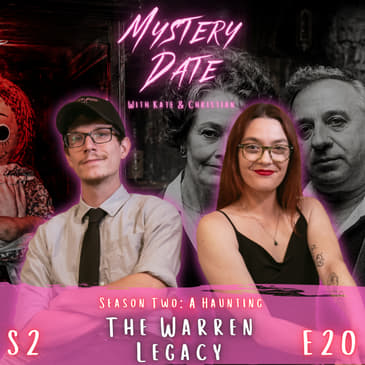
Ed and Lorraine Warren are two of the most famous paranormal investigators in history. To believers, they were spiritual warriors who helped terrified families face ghosts, demons, cursed objects, and impossible hauntings. To skeptics, they were master storytellers who turned fear into fame, books, lectures, museum tours, and eventually The Conjuring universe.
In this episode of Mystery Date Podcast, Christian and Kate investigate the complicated legacy of Ed and Lorraine Warren. Were they genuine paranormal pioneers, sincere believers, clever performers, or something much darker?
We explore their early lives, how they met, the founding of the New England Society for Psychic Research, the infamous Annabelle doll, the Amityville Horror, the Perron family haunting, the Enfield Poltergeist, the “Devil Made Me Do It” case, the Warren Occult Museum, their connection to the Catholic Church, their biggest skeptics, their most loyal supporters, and the Hollywood empire built from their cases.
Were Ed and Lorraine Warren telling the truth? Did they exaggerate their investigations? Or did they truly believe they were fighting evil?
This is the haunted legacy of the Warrens, and it is still on trial.
💌 Got a mystery or spooky story to share? We want to hear from you!Send your tales, tips, or local legends to us at mysterydatepodcast@gmail.com or call the mystery hotline at (216) 770-4881. You just might hear your story on a future episode!Follow Us for Updates & Behind-the-Scenes Chaos:Website: https://www.mysterydatepodcast.comInstagram: /mysterydatepodcastTikTok: /mysterydatepodcastShop: www.mysteryandco.comSources & Further Reading: Curious minds welcome!For a full list of sources, extras, and reading recommendations related to this episode, check out the episode blog on our website.Production:Mystery Date is written, edited, filmed, and produced by Christian Sullivan and Kate Sullivan. Music and sound are provided by Descript stock media and Artlist Media. We do not own the rights to any of the images shared in our episodes. All images in this video were sourced from Wiki Commons.
[00:00:00] Welcome to Mystery Date. This show was created first and foremost for entertainment purposes. While we do our best to research our topics, nothing discussed on this show should be taken as absolute fact. Opinions, theories, and interpretations are just that. Listener judgment is encouraged.
[00:00:15] Before the Conjuring, before Annabelle sat behind glass like a haunted celebrity, before Ed and Lorraine Warren became the first couple of American demonology, they were two young people from Bridgeport, Connecticut, building a life around faith, fear, and stories that would eventually change horror forever.
[00:00:39] To believers, the Warrens were spiritual warriors, walking into homes where families claimed something evil was scratching at the walls. To skeptics, they were master showmen who understood that a good haunting could become a lecture, a book, a movie, and a museum ticket.
[00:01:01] But the truth, as usual, lives somewhere in the locked room between devotion and deception. Tonight, we're looking past the Hollywood fog machine to ask who Ed and Lorraine Warren really were, what they actually proved, what they may have exaggerated, and whether their legacy is one of paranormal courage, carefully crafted myth-making, or something much closer to the truth.
[00:01:31] This is a mystery.
[00:02:15] They're the largest sale find from, like, probably seven years ago at this point. They lived their life. Yeah, they did their job. But now we got our whiskey glasses back out, which have made an appearance. Yeah. And once again, filled with juice. Yes. Yeah, we're sticking to the juice. It's hot outside. Yeah. Did a lot of yard work. I'm not trying to get schwifty tonight. Hey, get schwifty. Yeah, I'd know. I'd vomit. I'd really shit on the floor.
[00:02:45] Sorry, if you haven't seen Rick and Morty, you're probably like, the fuck? Yeah, that was probably weird for you. That was all reference humor. We do a lot of that, I'm sure you've noticed. Yeah. Are you new here? So, what do you know about the Warren legacy? Oh, boy. Anyway, we've talked a lot about the Warrens this season and during our movie night episodes between season one and season two.
[00:03:09] And I have some knowledge, probably still not a lot in the grand scheme of things, but some knowledge on the Warrens and some opinions on the Warrens. So, I'm excited. I'm excited to get into this more. You're excited to share them? Yeah, and I'm also excited to just learn more about their story and about them, like anything I don't know already that might either solidify my opinions and my feelings more or completely
[00:03:39] change them. Well, curious. Maybe there will be something in here. Well, before we get into the mystery, I just want to say this is the last official normal episode of season two. After this, we just have our season debrief where we're going to go through all of our mysteries and give them little rankings and little titles for, you know, the best haunting, the most true haunting, the best writing, stuff like that. They'll just be categories that will kind of rank them something fun for us all to do.
[00:04:05] And other than that, please like, share, comment, subscribe if you like the show. That helps us so much and it allows us to keep doing it and gets us in front of the eyes of many other people and we appreciate it. So with that out of the way, let's get into the mystery. There are some names in paranormal history that feel less like people and more like furniture in a haunted house. They are always there, sitting in the corner of the room, half covered in shadow, waiting for someone to turn on the lights.
[00:04:33] Ed and Lorraine Warren became two of the most recognizable paranormal investigators in American history. Not because they found one ghost or solved one haunting or proved one demon existed, but because they built an entire mythology around the idea that evil was real, active, and waiting behind the wallpaper. To believers, they were spiritual first responders. To skeptics, they were theatrical opportunists who discovered that fear could be shaped into
[00:05:03] books, lectures, museum tickets, and eventually a billion dollar horror empire. And somewhere in between those two versions is the actual legacy of Ed and Lorraine Warren. Complicated, fascinating, unsettling, and maybe a little too polished for comfort. This episode is not about proving whether ghosts are real. It is not about proving whether demons are real.
[00:05:28] It is about two people who made a career telling the world they were real, then asking them to trust them. And when you make claims that big, the evidence needs to be bigger than a creaking floorboard, a blurry photograph, or a story that gets scarier every time someone signs a book deal. Ed Warren was born Edward Warren Minnie on September 7th, 1926 in Bridgeport, Connecticut.
[00:05:53] Lorraine Warren was born Lorraine Rita Moran on January 31st, 1927, also in Bridgeport. That shared hometown matters because before they were paranormal celebrities, before the Haunted Museum and before Amityville and the Conjuring, they were just two teenagers from the same Connecticut city who came of age in a very different America. One shaped by the Great Depression, World War II, Catholic tradition, and a culture where
[00:06:20] the supernatural still lived quietly inside church pews. Ed often described himself as someone who had been exposed to the paranormal from a young age. The story he told was that he grew up in a haunted house and experienced strange phenomena that pushed him towards a lifelong interest in ghosts and spirits. Lorraine, meanwhile, claimed she had psychic sensitivity from childhood. Her public identity eventually became that of a clairvoyant and light trance medium,
[00:06:49] while Ed described himself as a self-taught demonologist. Ed as the man who studied evil and Lorraine, the woman who could sense it. And that's felt in the movies and The Conjuring and really in all of their stories, setting up the foundation of what the Warrens would become. Yeah, of who they are and them as a couple too.
[00:07:17] Also wild that Warren wasn't Ed's last name. Yeah, that actually shocked me. I don't know if you saw my face when you said that. I was kind of looking for this way with listening and you said it and I'm like, like, did I hear that wrong? Was there another name after Warren? Was that his middle name? Edward Warren Miney. And yes, it was his middle name. He just decided to go by Ed Warren as his professional name.
[00:07:41] So Lorraine Warren is also, I guess, Lorraine Rita Miney. And then Warren, I don't even know. It's just a stage name. See, already all we've done is introduce where they're freaking born. And already I'm like, a stage name? This is what I'm talking about with these guys. Yeah, Warren is essentially, yeah, it's a stage name.
[00:08:09] I mean, it's Ed's middle name, but that's it. And that's one thing. Like, if you went by your middle name or if you draw your last name and like, especially in high school or whatever, like stuff like that makes sense. But then for your wife to take your middle name as her married last name, at least publicly to ever like, that's kind of weird. That's at this point, it literally is a stage name. It's not just his nickname that he goes by. Well, and I'm fairly certain like Judy goes by Judy Warren.
[00:08:38] Yeah, that's what I'm saying. I'm like this, like you like changed your name, but you didn't. I don't these people, man. The couple married in 1945 when they were still very young. Their daughter, Judy, was born in 1946. By all public accounts, Ed and Lorraine presented themselves as a deeply bonded Catholic couple. And that image became central to their career.
[00:09:06] Their cases were not framed as curiosity-driven ghost hunts. They were framed as spiritual warfare. That made them different from many paranormal investigators who came later. The Warrens did not simply walk into a house and say, maybe this is residual energy. They often walked in with the language of infestation, oppression, possession, blessings, sins, demons, and God. Their religion was not a decorative candle on the table. It was the table.
[00:09:34] But this is also where the first tension begins. Ed was not an ordained priest. Lorraine was not a church official. Their authority came from reputation, experience, and their own claims. That does not automatically make them dishonest, but it does mean their public image relied heavily on trust. The Warrens were asking families, audiences, readers, to accept that they had access to a hidden spiritual world most people could not see
[00:10:03] and that they could identify when ordinary fear had crossed into the demonic. That is a powerful claim. It is also a profitable one. According to the broad version of the story, Ed first pursued art before becoming a paranormal investigator. He reportedly painted houses that were believed to be haunted, sometimes offering the artwork to homeowners and using the interaction as a way into their stories. Okay, so he's also an artist.
[00:10:32] I guess I sort of knew that from the movies, but I didn't know that that was like real. I didn't know he had a career in that first. I thought that was more of just like, oh, well, he paints for fun because he's stressed out. A lot of people do that who don't necessarily call themselves artists. I'm going to stop you right there real quick. I wouldn't say a career. Okay, fair. He drew random people's houses and walked inside and was like, hey, is your house haunted? Do you want this? That's what I'm saying, though.
[00:11:00] So he's like an aspiring artist who's trying to get into this very niche work with an ulterior motive of not just getting artwork out there, but getting into these homes and learning and becoming involved in haunting stories. Like that was always him at his MO. And he like from the get go, it sounds like he's being shady about it.
[00:11:26] Like just finds houses that are believed to be haunted, rolls up and he's like, hey, I'll paint your house for you. If you just tell me everything, you know, tell me it's haunted. Let me live here for three days and experience it myself. Like and tell people that I painted your haunted house. Yeah, tell everyone, you know, like I just already again, we're not that far into the story.
[00:11:50] And every new information, every single new piece of information I've ever learned about the Warrens has only made me doubt them more and laugh at them more and be like, okay, no, they're definitely con artists. But I will say I do think it's to the point where they're self-deluded con artists. I think they've bought what they're selling so much harder than anyone else has. They're selling the truth to themselves. Exactly. So like they don't know they're con artists.
[00:12:20] They certainly don't see it that way. They're so, so in on their own Kool-Aid at this point. So I do believe that as well. So like, I guess take that as you will. I don't think they're necessarily malicious con artists, but they're con artists. We'll see what you think by the end of it. Whether that was clever networking, sincere curiosity or both, it helped create the early framework for what the Warrens would become.
[00:12:49] They were not scientists in lab coats. They were storytellers with a religious mission, an eye for atmosphere and an instinct for dramatic presentation. In 1952, Ed and Lorraine founded the New England Society of Psychic Research, or NESPR, in Monroe, Connecticut. The organization describes itself as New England's paranormal research headquarters and still presents the Warrens as the founders of a long-running investigative tradition.
[00:13:17] NESPR claims to investigate and document paranormal and psychic activity. And today it is led by Tony Spera, the Warrens' son-in-law. As soon as you said that name, I thought that sounds familiar and I just didn't think much of it. But of course. Yeah, I messaged you, Tony. What the fuck? Wanted to get you on the pod. I know we talk so great about your family. I was going to say, yeah, he don't want to be on our pod. He heard what I had to say about his in-laws. No, I'm sorry, Tony.
[00:13:46] I don't, nothing against you and we're not shitting on anybody. These are all allegations, but it's also allegations of what the fucking Warrens are saying. I'm going to say, it's their word against theirs. Like this. The founding of NESPR is one of the turning points in the Warrens story. It gave their work a name, an organization, and eventually a sense of institutional legitimacy. We Investigate Hauntings sounds like a hobby. Hey now, this isn't a hobby, this is a job.
[00:14:14] This is a career path that my parents are very proud of, thank you. We founded the New England Society for Psychic Research. Sounds like a file cabinet, a stamp pad, and a room full of people wearing serious expressions. That may seem like a small difference, but branding matters, especially in the paranormal world, where the line between research and performance can be thinner than a seance.
[00:14:39] NESPR and the Warrens later claimed that Ed and Lorraine investigated more than 10,000 cases over their career. I'm sorry. Let's pull out a calculator for a second, shall we? 10,000 cases. So 10,000 divided by 365 days a year.
[00:15:02] That's 27 consecutive years without a single day off investigating a new case every single day. And they said over 10,000. So that was a minimum. You see why I don't believe them? They worked really hard every single day. They never saw Judy. And it was always a new case.
[00:15:29] They never spent more than 24 hours at one case. No, realistically, what I think they're talking about is legitimately investigated. So if they read a newspaper and made a little note about it, that was an investigation in their eyes. They investigated into it. An investigation has been started. Once they started looking into anything, that was it. It wasn't necessarily they did 10,000. We went to the house. There wasn't 10,000 Amityvilles. I'm going to start telling people that I've written over 10,000 books.
[00:15:58] Because I've probably started that many. I've written the first sentence of that many books. Well, and you also got to think, too. Maybe they're just knocking cases out quick. Like someone calls and they're like, hey, I think I'm haunted. And they're like, what's going on? This and that. Oh, you're not haunted. It's the pipes. Yeah. You know what I mean? Solved. Yeah, solved. Done. Put it in the file. Another win for us. Somehow they got that. They got to 10,000.
[00:16:27] 27 years of a new case every single day. The Associated Press repeated that figure in its reporting after Lorraine's death, noting that their work helped spark wider public interest in paranormal subjects and inspired later film and television portrayals. That number, 10,000, is impressive, but it also raises a question. What qualifies as a case? A full investigation? A phone call?
[00:16:54] A lecture attendee telling them their attic felt weird? Without a publicly available archive that independently verifies the detail of all of these cases, the number functions more as a part of the Warren legend than as a checkable statistic. It may be true in some broad sense, but the fog machine is definitely running here. It's all about the theatrics. I'd like to believe that that's how they got it. Every lecture they did, they asked every single person.
[00:17:22] Have you ever experienced anything that was even remotely like a haunting? Raise your hand. Oh, there's three of them. And they go through and then they're like, all right. Three cases today. Because how? Even if you're... Well, and honestly, if you've done that many of something, like if you have actually invested 10,000 cases of anything, like not just paranormal, you wouldn't...
[00:17:50] If you're not documenting them all in some sort of archive, could that could then theoretically be released later for public eyes? You wouldn't know. After like a hundred or so, after two or three hundred max, you'd be like, how many have we done? I have a fucking lot at this point. Yeah. Man, I've lost count. A lot, a lot. It would just... No, you're right. You wouldn't have a number. You'd have to keep track of it some sort of way.
[00:18:19] If you didn't have the records, you wouldn't have a number. If you know for sure that's the number, where's the records? Well, hold on to that. So what was the Warrens' first case? Pinning this down is pretty difficult and that difficulty itself tells us something. Their early work does not appear to have entered the public record with the kind of documentation we would expect from later criminal cases, court records, or newspaper investigations.
[00:18:49] Instead, their early reputation developed through lectures, local cases, religious networks, private investigations, and eventually their own books. What we can say is that by the 1960s and the 1970s, the Warren formula had begun to take shape. A family-reported disturbing phenomena, the Warrens arrived, often with religious language and spiritual explanations.
[00:19:14] Lorraine sensed something, Ed categorized the haunting, and if the case was serious enough, the cause was not merely a ghost, but something darker. Then came blessings in the clergy, warnings about occult objects, and sometimes mass media attention. This formula reached a wider audience through cases like the Annabelle doll, the Perrin family haunting, and later Amityville. The Annabelle case became one of their most famous stories.
[00:19:42] A raggedy Ann doll that the Warrens claimed was not possessed by the spirit of a child as others had believed, but manipulated by something demonic. That idea became the cornerstone of their museum and later a major piece in the Conjuring universe. Which we never watched in the Annabelle movies. Maybe one day we will go back and watch those. I think those are the only ones left in the Conjuring universe that I haven't watched. Annabelle creation is the only one that's really worth it. Oh, okay. The other two are just...
[00:20:10] Yeah, I haven't seen any of them, but I think at this point I've seen the rest of that universe. We'll have to finish it then, we might as well. To supporters, this pattern showed consistency. The Warrens believed they understood how spirits and demons operated, and they applied that worldview case after case. To skeptics, it looked like a hammer discovering every shadow was a nail. A haunted object? Demonic. A troubled house? Demonic. A family under stress? Demonic.
[00:20:38] The Warrens' world had many doors, but a surprising number of them opened into the same basement. The Warrens' rise to fame was not instant. It was built over decades through lectures, books, media appearances, and their involvement in increasingly famous cases. Their timing mattered. In the 1970s, American pop culture was primed for possession and hauntings. The Exorcist exploded into theaters in 1973.
[00:21:06] Religious horror became commercially powerful. Audiences were fascinated by the idea that evil could enter the home. The body, the child, the bedroom. And the Warrens stepped into that cultural weather, carrying crucifixes, case files, and stories that sounded ready for paperback covers. Their biggest early rocket was Amityville. In 1975, George and Kathy Lutz moved into the house at 112 Ocean Avenue.
[00:21:35] There's a ghost on Ocean Avenue! There it is. In 1975, George and Kathy Lutz moved into the house at 112 Ocean Avenue in Amityville, New York, where Ronald DeFeo Jr. had murdered six members of his family the previous year. The Lutz family later claimed they fled the house after 28 days because of terrifying supernatural activity. The Warrens became associated with the case, and the story became a publishing and film phenomenon.
[00:22:03] The 1977 book, The Amityville Horror, and the 1979 film helped cement the haunting in American pop culture. But Amityville is also one of the strongest examples of why the Warren legacy is so controversial. Skeptics and investigators have long argued that the haunting was fabricated or exaggerated. One of the most damaging claims came from attorney William Weber, who said that he, author Jay
[00:22:30] Anson, and the Lutzes developed the horror story over wine. Skeptics such as Benjamin Radford had also argued that the Amityville story was contradicted by evidence and witness accounts. Lorraine Warren, however, publicly defended the case and rejected the idea that it was a hoax. This became the Warren pattern in miniature. A case becomes famous, the Warrens stand by it, skeptics pull at the threads, and supporters
[00:22:56] say skeptics were not there, did not feel what the family felt, and cannot disprove the supernatural. Critics say that the Warrens repeatedly benefited from stories that grew more dramatic as they moved from family claims to books, lectures, films, and museum displays. So, as their rise was going up, you already have like two camps being formed around these people. And we don't, I was going to plan a whole episode of it, but I turned it into just a little section
[00:23:23] of this episode where the Warrens like battled the church, essentially. We'll get into it. So I won't talk about it too much, but like they had adversaries that the movies very much kind of gloss over. At one point, Ed does make a line about it in like Last Rites. He says something to the one priest. He's like, you know the enemies we've had or the enemies we deal with in the church, but they never really address. Yeah. Oh, he has like one line where he's like, oh yeah, we know we're notorious with the church. We get it.
[00:23:54] It's like, okay. Like that's all they say about it. Haven't seen anything about that in the movie. But no, I, the, I know that I'm clearly in camp skeptic, so I'm biased in that way, whatever. But this is what happens. A case starts getting press coverage and then the Warrens show up and they go, this has the
[00:24:18] most heavy, horrifying demonic energy we have ever dealt with in any case. This is definitely the biggest one. And then after they say that, evidence starts to come out. That's like, this is probably pretty exaggerated or was straight up a hoax. And then the Warrens are like, fuck, we already said it was the most demonic, horrifying haunting we've ever seen. We got to stick by our guns. So they do.
[00:24:47] And then they just quietly recede into the background and away from the story. And leave the family to deal with whatever they just caused. And go find a new family who's getting press attention. To ruin their life. And repeat the cycle. And every case we've ever talked about where the Warrens show up, Ed or Lorraine or both have been like, yep. And at this moment, they said this was the most demonic, horrifying haunting they'd ever seen. I'm like, bitch, you say that every time. Every haunting to you is the most haunting.
[00:25:18] So this next section, I was going to do just a layout of the most famous cases. But as I was laying them out, their most famous cases are covered by, guess what? Your two favorite hosts here at Mystery Date. Yours truly. Just rewind a few episodes and you will find all of them. Exactly. So I'm just going to give a quick list and you can go back and find those Mystery Date episodes if you want to hear more about the Warrens and their little shenanigans. So there was the Perrin family case, which inspired the original Conjuring.
[00:25:46] There was Annabelle, which gave the Warrens their most famous object. The Enfield poltergeist in England became the most documented ghost story. The Arnie Cheyenne Johnson case, also known as the Devil Made Me Do It case, was the first claim of possession in the court of law. And then there was the Snedeker case, which we did not really cover. I was going to, but so many haunted houses this season. I just decided I don't want to do it. But I'll go over it quickly here because we did not cover this one.
[00:26:16] The Snedeker case, later dramatized as The Haunting in Connecticut, may be one of the most damaging to the Warrens' credibility. I've heard of that. Yeah, it's a movie and a book. Yeah. Very famous. Yeah. I can't remember if I've seen it. It's not in The Conjuring universe. They did make a Haunting in Connecticut movie. And I think Ed and Lorraine Warren are in it, but it's a different studio, different universe. I think it came before The Conjuring. I think it did. Yeah, I think it came before all The Conjuring stuff. So that's why The Conjuring movies never did that case.
[00:26:46] And it's also one of their most notoriously controversial cases. Author Ray Garten, who wrote In a Dark Place, later claimed the family's stories were inconsistent and that Ed Warren told him to use what he could to make the rest of the stories scary. John Zaffris, a Warren relative and paranormal investigator, disputed Garten's claims and defended the case. But Garten's account remains one of the most clearest insider accusations that the Warrens'
[00:27:14] true stories could be shaped into marketable horror, even when the facts did not hold together. No way did some family experience hauntings, call the Warrens for help, or at least the Warrens showed up and they said, sure, we'll accept your help. And the Warrens come inside and they're like, hey, no matter what happens, write this down and just make it as scary as possible. You'll thank me later.
[00:27:41] Yeah, they pretty much told this author like, hey, just add some stuff, make it scary. That's fucked. You can't do that. You can't claim a true story and then do that. One of the last most famous cases of theirs is the Smurl haunting in Pennsylvania, which is the pretty much central theme of the newest Conjuring movie, The Last Rites, even though they're barely fucking in it. The Smurl family, you could just take out, replace it with generic family A. It's the Warrens movie now.
[00:28:10] Yeah, it's all about Judy. Yes. Outside of those famous cases, we do know that there are apparently 10,000 other cases that the Warrens had investigated. At least. At least. So do your research and feel free to dive into the 10,000 of them. One of the most famous pieces of the Warren legacy is the Warren Occult Museum in Monroe, Connecticut. The museum was housed at the back of the Warrens property and contained objects they claimed
[00:28:40] were haunted, cursed, or connected to occult activity. Annabelle was the star attraction. Sealed in a glass case and surrounded by warnings, the museum also contained other artifacts tied to their 10,000 investigations and broader occult lore. Most of them were creepy music boxes. As The Conjuring will tell you that, yes, they always just collected some music box. Yeah, according to the movies, that's basically what happens. If you had a haunting at your house and your kid loved a music box, Ed's stealing it.
[00:29:09] Doesn't matter if it was connected to the haunting or not. That needs to go in the museum. Sorry. Sorry, kid. The museum helped turn the Warrens career into something tangible. A haunting is invisible once the family stops talking, but a doll in a case is different. It gives the story a body. It lets visitors stand in front of the legend and feel the theater of danger. That does not mean that every object was fake, but it does mean that the museum was one of
[00:29:37] the most effective pieces of paranormal branding in modern America. The museum closed to the public around 2019 with reports pointing to zoning concerns because the house was a residential property being used for public tours. Damn red tape. It's been like how many years and the city's like, you know what? I was just about to say, how did nobody rezone it or like get the right permits to change it to a different...
[00:30:03] Well, it probably wasn't that popular until The Conjuring. And then it started becoming so popular so fast that the town is like, hey, you gotta knock it off. Yeah. Having one weird guy come here every week isn't a big deal. Nobody's gonna bat an eye. Having lines out the door every day. Your neighbors are annoyed. Yeah. Yeah. Also, can we talk about how the start of your museum kind of feels a little bit like P.T. Barnum to me?
[00:30:34] It's like, oh, we're on the road doing theater tricks and scamming families. But you know what we could do is just have one location with a tent and start selling tickets. That's essentially what it was. I mean, I guarantee I'd sat down and he's like, man, could you imagine if we could charge people to come to our house? We don't even have to leave, Lorraine. We can just go to the antique store and buy a bunch of crap. Just go buy a Raggedy Ann doll from Walmart.
[00:31:02] Put it in that glass box. I'll bleach stain it a little bit. We'll make it look old. Perfect. I mean, that museum is dense. If you've seen pictures of it. Like. Oh, things are packed. Yeah. So, okay. So you've seen. It looks like a hoarders. Yes. Yeah. Like, it looks like. Oh, what's that? What's that show? Storage Wars. Yes. Like Garage. Yeah. Storage Wars. I think. Yeah. Where they just go to the different storage units and like bet on them and then open them and it's just filled.
[00:31:30] All kinds of random antique shit. That's what it looks like. No. Yeah. So there's no way unless there are 10,000 cases are actually investigated cases. Like they went somewhere. They investigated. They took something back. They had to have just bought a bunch of shit. It's hand-me-downs from their grandparents and parents. They're like, what do we do with all this random antique stuff from grandma? I don't know. But like, I feel wrong getting rid of it.
[00:32:00] I mean, it was grandma's, you know? All right. Just shove it in the parlor with the rest of our crap, I guess. Now, the former home in a cult museum is owned by comedian Matt Reif and YouTuber Elton Castey. And when I say owned, I do. It's kind of an asterisk there. They're like leasing it or something from Tony Spera. There's vague reports of there like being a 10-year lease loan buying situation.
[00:32:26] But for all intents and purposes, it really seems like the comedian, like Matt Reif and this other dude just have full reign and own this property. All right, then. But I just know that Tony Spera does say he's like, no, no, I still own it. So, I mean, I'm allegedly. I don't know what's real, what's not. Maybe like some sort of rent to own situation or. I don't know, man. This is where the Warren story becomes bigger than belief. The museum was not only a room of full haunted objects, but it was proof that their cases
[00:32:55] could keep generating attention long after the investigations ended. So now that we know a little bit about the Warrens' early life, their rise to fame, their most famous cases and their famous museum. Let's talk about what I teased a little bit earlier and the Warrens versus the church. Ed and Lorraine Warren were publicly Catholic, and they framed their work through Catholic ideas about demons, faith, evil, and spiritual protection.
[00:33:22] They often claimed they worked with the clergy or turned cases over to church authorities when exorcisms were needed. Lorraine once described her job as evaluating and documenting a case before turning it over to church authorities. But their relationship with official church authority is murkier than their public image sometimes suggests. A common claim repeated in Warren lore is that Ed was the only non-ordained demonologist recognized by the Catholic church, or even by the Vatican.
[00:33:52] That claim is difficult to verify. Catholic commentator Brad Minor writing The Catholic Thing noted that he could not find evidence of official recognition or endorsement from Rome, and questioned why such recognition would be expected when the Catholic church has its own right and office for exorcism. This matters because recognized by the Catholic church sounds much more authoritative than self-taught
[00:34:20] demonologist who sometimes worked around Catholic clergy. The first phrase sounds official. The second sounds like the kind of thing that could come with paperwork, footnotes, and maybe a cautious bishop standing nearby. This is probably the fairest way to say it. The Warrens were Catholic paranormal investigators who frequently used Catholic language, symbols, and clergy connection in their work. But the stronger claim that they were officially recognized by the Vatican appears unproven.
[00:34:50] That does not make every case false, but it does weaken one of the major authority signals attached to Ed Warren's public persona. I've brought that up before. I don't know if it was in one of our episodes or just when we were watching The Conjuring movies, but I know I brought it up before where I'm not even Catholic, okay? But I grew up Christian, like mostly Baptist. I know about Catholicism. I've been to Catholic mass. I've had Catholic friends.
[00:35:19] I've been to various Christian churches. Like, they're pretty strict with that stuff. Especially the Roman Catholics. The Vatican, they're very strict. They take that shit seriously and they do it by the book. You don't think they would have? So if they're like, our rules say you have to go through this official process to get
[00:35:45] your first communion or to get confirmed or whatever and then go get ordained and then get priesthood and then you can perform an exorcism. They're not going to look at some guy who comes in and is like, I've gone to church my whole life, I swear, and I've taught myself this stuff. So I've got it. And just be like, we trust you, son. Here's an honoree badge. You're the only one, though.
[00:36:14] You're the only one. The only one we've ever done this to. Fuck out of here. No way the Pope said yes to that shit. So now we're going to get into the fall of the Warrens. The Warrens never fully fell in the sense of disappearing from culture. If anything, their fame grew after Ed's death and exploded with the Conjuring franchise. But their credibility has taken repeated hits.
[00:36:42] The New England Skeptical Society investigated the Warrens in the 1990s. And according to AP reporting, the group criticized the Warrens for having far more anecdotal haunting reports than strong physical evidence. Steve Novella and Perry DeAngelis reportedly found the Warrens pleasantly personal, but deeply unconvincing as investigators. Their criticism was not simply, we do not believe in ghosts.
[00:37:08] It was that the Warrens appeared to begin with a conclusion and then interpret evidence through that conclusion. That critique is central. A good investigation asks what is happening. A bad investigation asks which demon is this. Once the answer is already waiting at the bottom of the stairs, every noise becomes confirmation. Ray Garten's comments about the Snedeker case are another major blow.
[00:37:32] In a 2009 report from the New Haven Register, Garten said that the story was concocted to sell a book and possibly a movie, and claimed the family could not keep its story straight. He also alleged Ed Warren told him to make the story scary where details did not fit. John Zaffis rejected those accusations and insisted the haunting was real.
[00:37:54] But still, Garten's accounts remain serious because it came from someone directly involved in turning a Warren case into a publicized true haunting. There are also personal allegations. In 2017, The Hollywood Reporter covered disturbing claims tied to a legal battle over the Conjuring franchise, including allegations by Judith Penny involving Ed Warren and the Warrens' private life. These claims are contested by the Warrens' family and supporters,
[00:38:22] and because Ed and Lorraine are no longer alive to respond in court or on record, they should be handled carefully, but they are part of the modern reassessment of the Warrens' image, especially because their brand depended so heavily on moral authority, Catholic virtue, and the portrayal of their marriage as nearly saintly, even without the personal allegations. The biggest problem for the Warrens is evidentiary. Their best-known cases often became famous through books and films,
[00:38:51] not through independently verifiable proof. Supporters say paranormal evidence is difficult to capture and that skeptics move the goalposts. Critics say the Warrens sold certainty where uncertainty was the only honest product on the shelf. This is one of the hardest questions to answer responsibly because there does not appear to be a public, audited accounting of the Warrens' lifetime income. From investigations, books, lectures, museum tours, consulting, rights deals, or media appearances.
[00:39:19] So any number here has to be treated as an estimate, not a fact. The Warrens and their supporters have often claimed they did not charge families for investigations, aside from expenses like travel or incidentals. If true, that means their direct income likely came from the ecosystem around the investigations. Those lectures, books, appearances, that's what made them money. The films inspired by or based on their cases made enormous money,
[00:39:49] but that does not mean the Warrens personally received a large percentage of those grosses. Box Office Mojo lists major domestic grosses for The Conjuring Universe films, with entries like The Conjuring, The Nun, Annabelle, and later The Conjuring Last Rites, earning major theatrical revenue. The franchise as a whole has been widely reported as one of the most successful horror franchises ever. A cautious estimate would be this.
[00:40:15] During their lifetime, Ed and Lorraine Warren likely profited somewhere from the hundreds of thousands into the low millions over several decades from their paranormal brand, depending on book royalties, fees, museum revenue, and all their contracts. That is not a confirmed number. It is a reasoned range based on the fact that they maintained a public career for decades, published and contributed to multiple books, lectured regularly, opened a museum,
[00:40:43] and became attached to valuable intellectual property. But the billions made by the larger Conjuring Universe mostly belongs to the studios, producers, distributors, and the rights holders. The more important point might not be the exact dollar amount. It is that their investigations generated a profitable mythology. Even if they've never handed a terrified family an invoice for one demonic infestation inspection, the stories themselves become assets.
[00:41:11] And once fear becomes an asset, every claim deserves scrutiny. So, they were well off. Yeah. And like, here's the thing. If you weren't at all con artists, would you really feel okay sleeping at night? Making money off of these people's trauma by going and doing a press tour about it
[00:41:37] and charging tickets to see their old family heirlooms that you now are claiming are haunted objects? Like, is this really how you want to make your money if your actual goal was to help these people? And you're apparently Catholic? Yeah. That's what I'm saying. I'm like, mm, you didn't have to get rich rich from this. But you did. Unless the only money you ever took from this kind of work was like donations.
[00:42:06] I'm just saying it's a little bit, it's like it's a little bit dirty money. It kind of is. No, yeah. It's a little bit scandalous. It's a little bit of a joke. And you have now, I mean, they're paying entire employees, like salaries of employees at studios because of the brand. Yeah. And I mean, as somebody who watches every documentary I can find myself, I have heard that there are people out there who give documentaries shit all the time
[00:42:35] just for even existing when it comes to things like true crime or anytime there was a victim involved. They're like nature documentary, go for it. If you're talking about somebody who has died or like this poor family who went through this horrible thing, you shouldn't be making this content, period. Or you should not be profiting off of it. Yeah. That's how a lot of people feel.
[00:43:00] But with the Warrens, it's okay because it's demons and the church, except not the church, just sort of the church. Ed. Yeah. But the church said it's okay. Or did they? Like, I cannot. So what is the legacy of Ed and Lorraine Warren? Ed! Lorraine! That's their legacy. Yeah. Probably. Screaming for each other in various people's homes.
[00:43:30] If you are a believer, they were pioneers. They entered homes no one else understood, comforted families, confronted forces they believed were dangerous, and helped make the paranormal part of mainstream conversation. They gave language to people who felt haunted. They built a system, a society, a museum, and a body of stories that still shapes how Americans imagine demons, cursed objects, and haunted houses. If you're a skeptic,
[00:43:57] they were at best sincere but unreliable storytellers, and at worst, opportunists who turned vulnerable families into content. They repeatedly attached themselves to cases that later showed signs of exaggeration, contradiction, or commercial incentive. Their evidence often failed to match the size of their claims. Their religious authority may have been overstated. Their cases became books and films, and the scarier the story became, the more valuable it was.
[00:44:27] The truth may be uncomfortable because it does not fit neatly into either camp. Ed and Lorraine Warren might not have been the mustache-twirling fraud sitting in the candlelit office investigating demons, but they also do not appear to have been neutral investigators carefully eliminating ordinary explanations before declaring spiritual war. Their work lived in the blurry middle, where sincere belief, religious conviction, family distress, and showmanship
[00:44:56] all fed into one another. And that might be the real haunting. Not Annabelle in her glass case, not footsteps in Amityville, and not a shadow in the parent farmhouse, but the thing that lingers is the question of what happens when people in pain meet people with a ready-made supernatural answer. Sometimes, that answer comforts. Sometimes, it exploits. And sometimes, it becomes a movie. Ed and Lorraine Warren left behind
[00:45:25] one of the most influential paranormal legacies in modern history. But influence is not the same as truth. Fame is not evidence, and a story does not become factual because someone whispers based on true events before the credits roll. Maybe the Warrens saw something. Maybe they believed everything. Maybe they did help people, and maybe they embellished more than they admitted. Or, maybe they built an empire out of other people's fear and called it a calling. Whatever the answer,
[00:45:54] their legacy is not just haunted. It's still on trial. So, do you think Ed and Lorraine Warren were genuine demonologists or just con artists? I stick to my original assessment. I think that they fully believe what they're selling, or at least mostly believe what they're selling. Of course, now I know that apparently Ed was whispering to haunted kids to, don't forget, when the details get hazy in the book,
[00:46:23] just make it scary and it'll sell. Well, he whispered that to the author that wrote the book. Yeah, but still, I mean, it's the same thing. Like, it'd be fucked up if he whispered to the kids. Yeah, but still, they're like, all right, hey, I'm going to need to confront you on the details of this story to write this book. Some of these details you told me, they're not really adding up. Can you help clarify? Yeah, they're not going to add up. Just make a really scary scene and then people will forget about my plot holes. There, move on. Make it scary.
[00:46:53] I'm like, I'm sorry, but that response right there did make me think maybe they aren't fully convinced of their own BS. Maybe they do know exactly what they're doing just a little bit. But no, for the most part, I stick to my original assessment. I think from their perspective, they totally believe it all. They believe what they're saying. They believe what they're doing. They believe what they're seeing. But I think that a lot of it is kind of just bullshit
[00:47:23] and taking advantage of a situation to make themselves famous and get more money or get more of that reputation they were hoping to gain and did gain. So, no, I don't really think they were real demonologists and clairvoyants and psychics and whatever. I think that they were religious people down a rabbit hole. Yeah, I agree with you. I mean, I think that
[00:47:51] it got carried away from them. I think it started out very sincere. Maybe they did genuinely believe what they were doing. But the more that the money came in and the more that the books began to profit and they saw this easy funnel to get more money, I think that's when it started to strain. and you started to get stories like the Snedeker case or Amityville where you have Roger basically being like, Ed, I'm going to punch you in the face. I think it did hit him at one point. But yeah, he was like,
[00:48:20] get out of my house. Those are my favorite Warren stories is when nobody called them or asked for them. The press was there. So they showed up and said, don't worry, we're here to help. The family said, okay, fine. If you say you can help, help. And within days, the family's like, get out. Yeah. So did it start genuine? Maybe. I'd like to believe so because I like to believe in the good of humanity. Me too.
[00:48:50] But I believe once the money started flowing, then those mustaches started twirling. Yeah. Yeah. Then Ed started running the books and he's like, you know, every haunting we do in book we sell, we make a lot of money. He's like, I wonder if I started telling people that we're connected to the Vatican. Like, I just think it's like so many compounding things and at the end of the day, could you call that a con artist? Yeah, because I think once it started reaching the mass capacity
[00:49:20] that it did, that was only achieved because they wanted money and they saw an easy way to get it, which is essentially the definition of a con artist. So I don't even know if it was necessarily about the money for them. I think they were more in it for the fame. I think it was, I mean, it's always fame, but money's, it's money. they're hand in hand. Yeah. What am I saying? Especially growing up like in a small town in Connecticut. Once they started getting it, it's like, okay, well, they grew up during the depression. They got that first taste of a big paycheck
[00:49:49] and they were like, oh, drooling. So, no, I don't think they're genuine. Maybe they're early cases, but 10,000? No, bro, fuck that. Yeah. You're just making shit up. That's a lot. Ain't no way you did a minimum of 10,000 cases. So, that's our last mystery of the season. Our next one's going to be a debrief. So with that, we're going to move on to our date night debrief, which my question for today is in conjunction
[00:50:19] with the episode, do you think we could convince people that we can fight demons? No. No, because we've talked about this a little bit before too. As A, I'm a huge skeptic, so it's hard for me to walk into a place and be like, yes, for sure there is demons here. Like, I wouldn't be able to take myself seriously. Or, if that's scenario one, what could happen? Or, on the opposite side, what might happen
[00:50:47] is I'd walk into a place and actually start to feel scared because I'd be like, oh shit, maybe this place is haunted. And then I wouldn't know what to do or how to play it off. Like, I did know what I was doing. I'd just be like, your place is hot. You gotta go. Sell it. Yeah, I'd be like, list this place on the market tomorrow, tell no one that it's haunted and just get the fuck out. Sorry, bro. That's my advice. All right, all right. No, that's fair. That's fair. Like, that's probably how I would do it.
[00:51:17] I think we could do it. So if you need a demon investigation, we are professionals officially recognized by the Vatican. Yeah. Self-taught. Let's see. We've done like 20 episodes of hauntings. In those 20 episodes, I've probably researched like 60 more cases that we didn't do, at least roughly. So we're already at like 80 cases that we've investigated. Yeah. So like five more and we'll be at 10,000, right? That's how the Warren's mathed. So we're just as good
[00:51:47] as them. Do you have any free talk or anything you want to add? I will say as much as like, you know, I talk a lot of shit about the Warren's. I laugh at them a lot. They show up and I'm like, here we go. But no, like I don't, I think they were kind of con artists. I am still glad that they did everything they did because like you said, they've kind of formed this new mythology,
[00:52:17] this whole new like outlook on paranormal things. And it's probably been an influence in the way ghost hunting has evolved from seances into this new technology and using cameras and whatnot. Like they were a big deal in the spooky community. I mean, this whole season religious or non-religious purposes. This whole season probably wouldn't have happened if it wasn't for the Warrens and the building of that mythology. That's what I'm saying. And I talked a lot of shit on these too,
[00:52:47] but I did like The Conjuring movies. Yeah, they're fun. At least the first two I thought were really good. Yeah. So I'm like, yeah, it's content. It's fun. It's all fun and games. That's all life's about anyway. So as much as I talk shit on them, I'm like, I do still appreciate them. I mean, yeah, all in all, what they did for the zeitgeist and the paranormal community could be argued if it was positive or negative, but it did put it to where it is today for sure.
[00:53:18] So I do agree with you there. A lot of what we know about demons and hauntings and all of that stuff come from Ed and Lorraine Warren. So any other free talk or anything? This might be one of the last episodes of season two. We don't have a lot going on other than no wedding season. Wedding season's about to start. bulk recording for that. So some of season three might seem a little, season three is going to be different. I'll say that. We're kind of touring around with how we want to do it
[00:53:46] and also just some personal stuff. I'm losing my job. So we just got to figure out a new rhythm to get everything in order and in balance. It's not going away, but we may end up going back to an every other week format for season three, at least for the time being, just to get everything feeling a little better, less burnt out on our end and make sure I have a living. Yeah, we just, you know, got to rearrange priorities for a second here, but I'm excited for season three and for our trailer that we're going to be working on soon.
[00:54:16] Yes, we'll be working on that. That'll be fun. Other than that, I don't know if there will be too much we'll be doing in the meantime. We're going to see therapy gecko in June. Yes, that's going to be really fun. That'll be fun. And then we're seeing bug hunter in July. Yes. And narcissist cookbook. Yes. So those will be really good and $30 for each. So yeah. So if you're in the Cleveland or Akron area, like it's a steal. Oh yeah. Do it. Therapy Gecko has a whole tour. So if you don't know who that is, watch them. Highly recommend it. Yeah. Love them.
[00:54:47] But other than that, I think that's about it. So thank you guys joining us for another mystery and another episode. We hope you all enjoyed today's episode and story. And don't forget, you can email us your own episode ideas. Give us your opinions on what season three, four, five themes should be. Tell us about your own hauntings. Give us anything. We want to hear from you. Tell us that we're pretty. Just reach out. We're here and we're like begging for it. Just talk to us. You can reach out
[00:55:16] on social media at mystery date podcast on all platforms through email mystery date podcast at gmail.com on our website, mystery date podcast.com where you can leave a little voice message or you can even call us at the mystery hotline, which the number is in the description. Please share this with anyone, please. I don't know how to follow that. No, but for real, share this with anyone, you know, that loves mysteries, conspiracies, or anything of the sorts, hauntings.
[00:55:45] This show doesn't just dive into whatever the specific season topics are. We're going to be exploring all of the unknown in the world, slowly season by season, building a catalog that will hopefully be there for a long time for everyone to go back and just pick something that they're interested in or that they want to learn about. The more you share it, the more that allows us to build this catalog and get this off the ground and makes the mothership actually fly and allows us to do something. So please like, share, subscribe, comment, anything you can do to interact with this show helps so much
[00:56:15] and a little indie creators like us, it makes us do happy dances every single time. So I can't tell you how much we appreciate it. It's been a blast and I can't wait for season three coming up, but we still have our debrief. So keep an eye out for that. That's all. So be safe and have a great rest of your day or night. And remember, every good mystery deserves a date. Bye. Bye.