
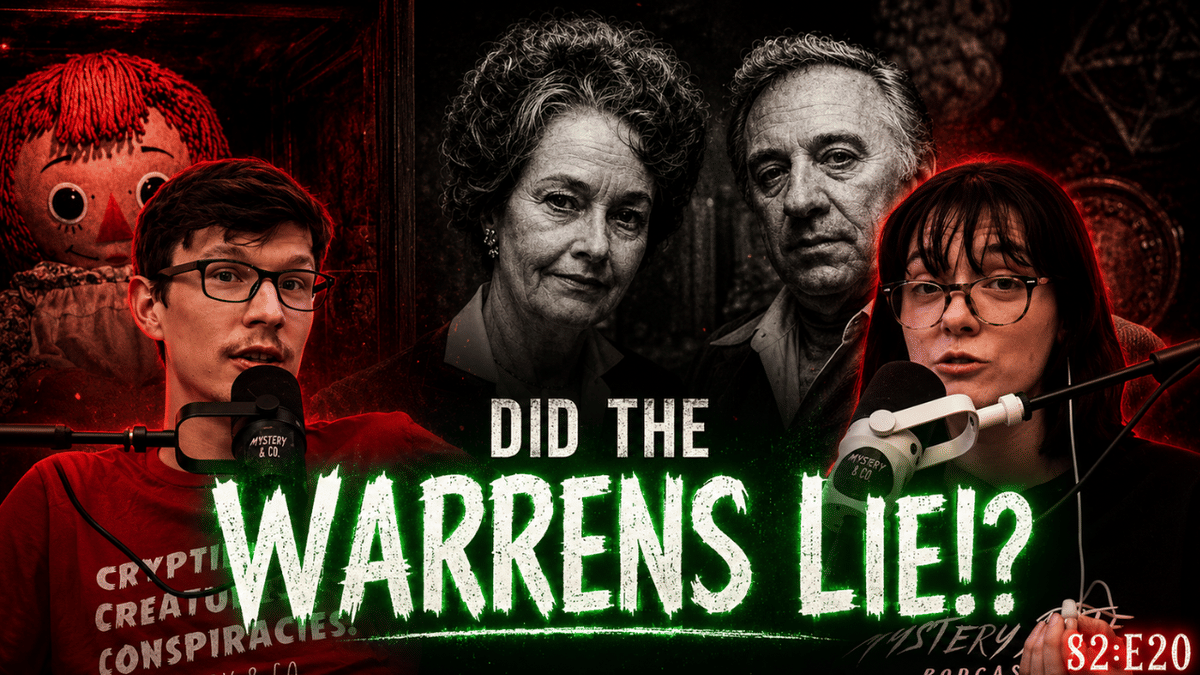
Ed and Lorraine Warren: Paranormal Pioneers, Storytellers, or Something Worse?
Few names in paranormal history carry as much weight as Ed and Lorraine Warren. For believers, they were brave investigators who walked into haunted homes, confronted demonic forces, and helped terrified families when no one else would listen. For skeptics, they were gifted storytellers who turned fear into a business model through books, lectures, museum tours, and eventually one of the most successful horror franchises of all time.
Their legacy sits somewhere in the fog between faith and fame.
Ed and Lorraine Warren became two of the most recognizable paranormal investigators in American history, not because of one haunting, one ghost, or one piece of undeniable evidence, but because they helped shape the way modern audiences think about haunted houses, cursed objects, demonic possession, and “true story” horror.
But the question remains:
Did the Warrens really uncover proof of the supernatural, or did they build a mythology out of other people’s fear?
Who Were Ed and Lorraine Warren?
Ed Warren, born Edward Warren Miney in 1926, and Lorraine Warren, born Lorraine Rita Moran in 1927, both came from Bridgeport, Connecticut. Long before they became paranormal celebrities, they were a young Catholic couple growing up in an America shaped by the Great Depression, World War II, church tradition, and a culture where ghost stories still lingered quietly in old homes and family histories.
Ed described himself as a self-taught demonologist, while Lorraine claimed to be a clairvoyant and light trance medium. Together, they created a public identity built around spiritual warfare. Ed studied evil. Lorraine sensed it. That became the foundation of the Warren brand.
The couple married in 1945 and later founded the New England Society for Psychic Research, often shortened to NESPR, in 1952. The organization helped give their paranormal work an official-sounding structure. They were no longer simply a couple interested in ghost stories. They were investigators with case files, lectures, religious language, and a growing reputation.
Over the years, the Warrens claimed to have investigated thousands of paranormal cases. Some supporters cite them as pioneers of modern paranormal research. Critics argue that many of their claims relied more on personal testimony, dramatic storytelling, and religious belief than verifiable evidence.
The Warren Formula: Hauntings, Demons, and Spiritual Warfare
One of the reasons Ed and Lorraine Warren became so famous is that their cases often followed a powerful narrative pattern.
A family experiences strange activity. The Warrens arrive. Lorraine senses a presence. Ed identifies the haunting. If the situation is serious enough, the explanation often moves beyond ghosts and into the demonic. Then come blessings, clergy involvement, warnings about occult objects, and sometimes media attention.
For believers, this consistency made the Warrens seem experienced and reliable. They had a framework. They knew what signs to look for. They understood evil in a way the average person did not.
For skeptics, that same pattern looked suspicious. If every unexplained noise, strange feeling, or frightening experience could be interpreted as demonic, then the conclusion may have been decided before the investigation even began.
That tension follows the Warrens through nearly every famous case connected to their name.
The Warrens and the Annabelle Doll
One of the most famous Warren stories is the case of Annabelle, the allegedly haunted Raggedy Ann doll. According to the Warrens, the doll was not simply haunted by the spirit of a child. Instead, they claimed it was manipulated by something demonic.
Annabelle became one of the most iconic objects in the Warren Occult Museum and later inspired several films in The Conjuring universe. Whether someone believes the doll is truly dangerous or not, Annabelle is one of the clearest examples of the Warrens’ ability to turn an object into a legend.
A simple doll became a symbol of evil. A glass case became a stage. A warning sign became part of the story.
That was one of the Warrens’ greatest strengths. They understood the power of atmosphere.
The Amityville Horror and the Warrens’ Rise to Fame
The case that helped push the Warrens deeper into mainstream paranormal culture was The Amityville Horror.
In 1975, George and Kathy Lutz moved into the infamous house at 112 Ocean Avenue in Amityville, New York. The year before, Ronald DeFeo Jr. had murdered six members of his family inside the home. The Lutz family later claimed they fled the house after 28 days of terrifying supernatural activity.
The story became a bestselling book in 1977 and a major film in 1979. The Warrens became associated with the case, and Amityville became one of the most famous haunted house stories in American history.
But Amityville is also one of the most controversial cases tied to the Warrens. Skeptics have long argued that the haunting was exaggerated or fabricated. Some claims suggest the story was shaped for publicity and profit. Lorraine Warren, however, defended the case and rejected the idea that it was a hoax.
This is the Warren legacy in miniature: a terrifying story, massive public attention, passionate believers, loud skeptics, and evidence that never quite rises to the level of the claims.
The Perron Family and The Conjuring
The Perron family haunting became the foundation for the 2013 film The Conjuring. The case involved alleged paranormal activity at a Rhode Island farmhouse in the 1970s. The Warrens were brought in after the family reported frightening events in the home.
The movie turned Ed and Lorraine Warren into horror heroes for a new generation. Played by Patrick Wilson and Vera Farmiga, they were portrayed as loving, faithful, brave investigators risking themselves to save families from supernatural evil.
But Hollywood is not a court transcript.
Family members have said the film took major creative liberties. That does not mean nothing happened in the house. It does mean the movie version of the Warrens is polished, simplified, and emotionally sharpened for the screen.
The real story is much messier.
The Enfield Poltergeist and Questions About Their Role
The Enfield Poltergeist case in England became another major Warren-linked story after The Conjuring 2. The film presents Ed and Lorraine as central figures in the investigation.
In reality, their role appears to have been much smaller.
Other investigators connected to the case have suggested the Warrens were not deeply involved. This matters because it shows how the Warren legend grew beyond the original details of certain cases. Their names became so strongly associated with paranormal authority that later retellings sometimes placed them closer to the center than the historical record supports.
That does not necessarily mean the Warrens lied about everything. But it does show how easily paranormal history can become paranormal branding.
The “Devil Made Me Do It” Case
Another infamous Warren case involved Arne Cheyenne Johnson, whose 1981 manslaughter case became known as the “Devil Made Me Do It” case.
Johnson’s defense attempted to argue that he was possessed when he killed Alan Bono. The judge rejected that defense, and Johnson was convicted of first-degree manslaughter.
The Warrens had been involved before the killing through the alleged possession of David Glatzel, the younger brother of Johnson’s fiancée. The case remains one of the strangest intersections of paranormal belief, criminal law, and media attention in modern American history.
It also raises uncomfortable questions. What happens when claims of possession move from a haunted house story into a courtroom? What happens when spiritual explanations are attached to real violence?
Those questions are part of why the Warren legacy remains so complicated.
The Warren Occult Museum
The Warren Occult Museum in Monroe, Connecticut, became one of the most famous parts of their paranormal empire. Housed behind the Warrens’ property, it contained objects they claimed were haunted, cursed, or connected to occult activity.
Annabelle was the star attraction.
The museum gave the Warrens’ stories a physical home. A haunting can fade when the family stops talking. A doll in a case is different. It gives the legend a body. It lets visitors stand in front of the story and feel like they are near something dangerous.
The museum helped turn the Warren legacy into something people could see, visit, photograph, and talk about. It was part archive, part attraction, part chapel of dread. Tiny haunted Disneyland, but with more crucifixes and worse vibes.
The museum later closed to the public, reportedly due to zoning issues, but its artifacts and stories remain a major part of paranormal pop culture.
Were the Warrens Recognized by the Catholic Church?
The Warrens were deeply associated with Catholic imagery and language. They often spoke about demons, blessings, exorcisms, faith, sin, and spiritual protection. Their public identity leaned heavily on the idea that their work was connected to religious authority.
One common claim is that Ed Warren was the only non-ordained demonologist recognized by the Catholic Church or the Vatican. However, that claim is difficult to verify through publicly available documentation.
That distinction matters.
There is a big difference between being a Catholic paranormal investigator who sometimes worked with clergy and being officially recognized by the Vatican. The first is plausible. The second requires stronger evidence.
This does not automatically disprove the Warrens’ cases, but it does weaken one of the major authority signals attached to their public image.
Why Skeptics Question the Warrens
Skeptics have criticized the Warrens for decades. The biggest criticism is not simply that ghosts and demons are hard to prove. It is that the Warrens often appeared to begin with a supernatural conclusion and interpret events through that lens.
Critics argue that many Warren cases relied heavily on anecdotal evidence, emotional testimony, inconsistent stories, and later dramatizations through books and films. Some writers and investigators connected to Warren-related projects have claimed that stories were exaggerated to make them more frightening or commercially appealing.
That is the core problem.
If a case becomes scarier every time it gets closer to a book deal, movie option, or museum display, skepticism is not just fair. It is necessary.
The Warrens made enormous claims. Demons. Possession. Cursed objects. Spiritual warfare. Evil forces attacking families.
Claims that big require evidence just as big.
Why People Still Believe Ed and Lorraine Warren
It would be too easy to dismiss every Warren supporter as gullible. Many families who contacted the Warrens were genuinely afraid. They believed something was happening. Whether the cause was supernatural, psychological, environmental, social, or some tangled combination, those families felt unheard.
The Warrens gave them a framework. They listened. They showed up. They said, “You are not crazy. Something is happening.”
That kind of validation is powerful.
Supporters argue that Ed and Lorraine spent decades helping families, often without charging direct investigation fees. They believe the Warrens were sincere people working in a field where proof is difficult and ridicule comes easily.
And maybe that is part of what makes their story so hard to untangle.
The Warrens may have helped people. They may have sincerely believed much of what they said. They may also have exaggerated, dramatized, and profited from those stories in ways that deserve serious criticism.
All of those things can exist in the same haunted hallway.
Did Ed and Lorraine Warren Profit from Their Cases?
The exact amount Ed and Lorraine Warren made from their paranormal work is difficult to confirm. There does not appear to be a clear public accounting of their lifetime income from lectures, books, museum tours, media appearances, consulting, or rights deals.
The Warrens and their supporters often claimed they did not charge families directly for investigations, aside from expenses. But even if that is true, their income likely came from the larger ecosystem around the cases: books, lectures, appearances, museum interest, consulting, and media opportunities.
The larger Conjuring universe has made enormous money, but that does not mean the Warrens personally received a large share of those profits. Studios, producers, distributors, and rights holders would have captured much of the revenue.
Still, the stories connected to the Warrens became extremely valuable. Their investigations created a mythology that could be packaged, sold, adapted, and revisited again and again.
Even if they never handed a terrified family a bill for “demonic infestation inspection,” the stories themselves became assets.
And once fear becomes an asset, every claim deserves extra scrutiny.
The Deaths of Ed and Lorraine Warren
Ed Warren died in 2006 at the age of 79. Lorraine Warren died in 2019 at the age of 92.
After Ed’s death, Lorraine remained the public face of the Warren legacy. She consulted on The Conjuring and became closely connected to Vera Farmiga’s portrayal of her. That portrayal helped reshape how many modern viewers see the Warrens.
To a new generation, Ed and Lorraine are not just controversial paranormal investigators. They are cinematic heroes. They are the loving couple who walks into the haunted house when everyone else runs out.
But movies are emotional machines. They simplify. They polish. They light the subject beautifully and trim away the inconvenient shadows.
The real Ed and Lorraine Warren remain harder to define.
So, Were the Warrens Heroes or Con Artists?
That depends on who you ask.
To believers, Ed and Lorraine Warren were pioneers who gave families hope, confronted evil, and helped bring paranormal investigation into the mainstream.
To skeptics, they were unreliable storytellers who attached themselves to frightening claims, overstated their authority, and benefited from stories that became more dramatic as they became more profitable.
The truth may be somewhere in the middle.
Ed and Lorraine Warren may not have been cartoon villains inventing demons in a candlelit office. But they also do not appear to have been neutral investigators carefully eliminating ordinary explanations before declaring spiritual war.
Their work lived in the blurry space between faith, fear, performance, family trauma, religious conviction, showmanship, and money.
And that may be the real haunting.
Not Annabelle in her case. Not footsteps in Amityville. Not a shadow in the Perron farmhouse.
The thing that lingers is the question of what happens when people in pain meet people with a ready-made supernatural answer. Sometimes that answer comforts. Sometimes it exploits. Sometimes it becomes a movie. Sometimes it becomes a museum ticket. Sometimes it becomes a legend so powerful that decades later, we are still trying to separate the ghost from the business model.
Ed and Lorraine Warren left behind one of the most influential paranormal legacies in modern history.
But influence is not proof.
Fame is not evidence.
And a scary story does not become true just because someone whispers, “based on true events.”
Their legacy is not just haunted.
It is still on trial.
About This Episode
This blog post is adapted from our Season 2 episode of the Mystery Date Podcast — “The Warren Legacy | Saints of the Supernatural or Masters of the Con?”, part of our A Haunting season exploring the strange and mysterious side of the paranormal.
🎧 Listen to the full episode: Mystery Date Podcast
👕 Grab themed merch: Mystery and Co.
📬 Send us your local legends: mysterydatepodcast@gmail.com | (216) 770-4881