
The History of The Ship
The Race To Be Fast
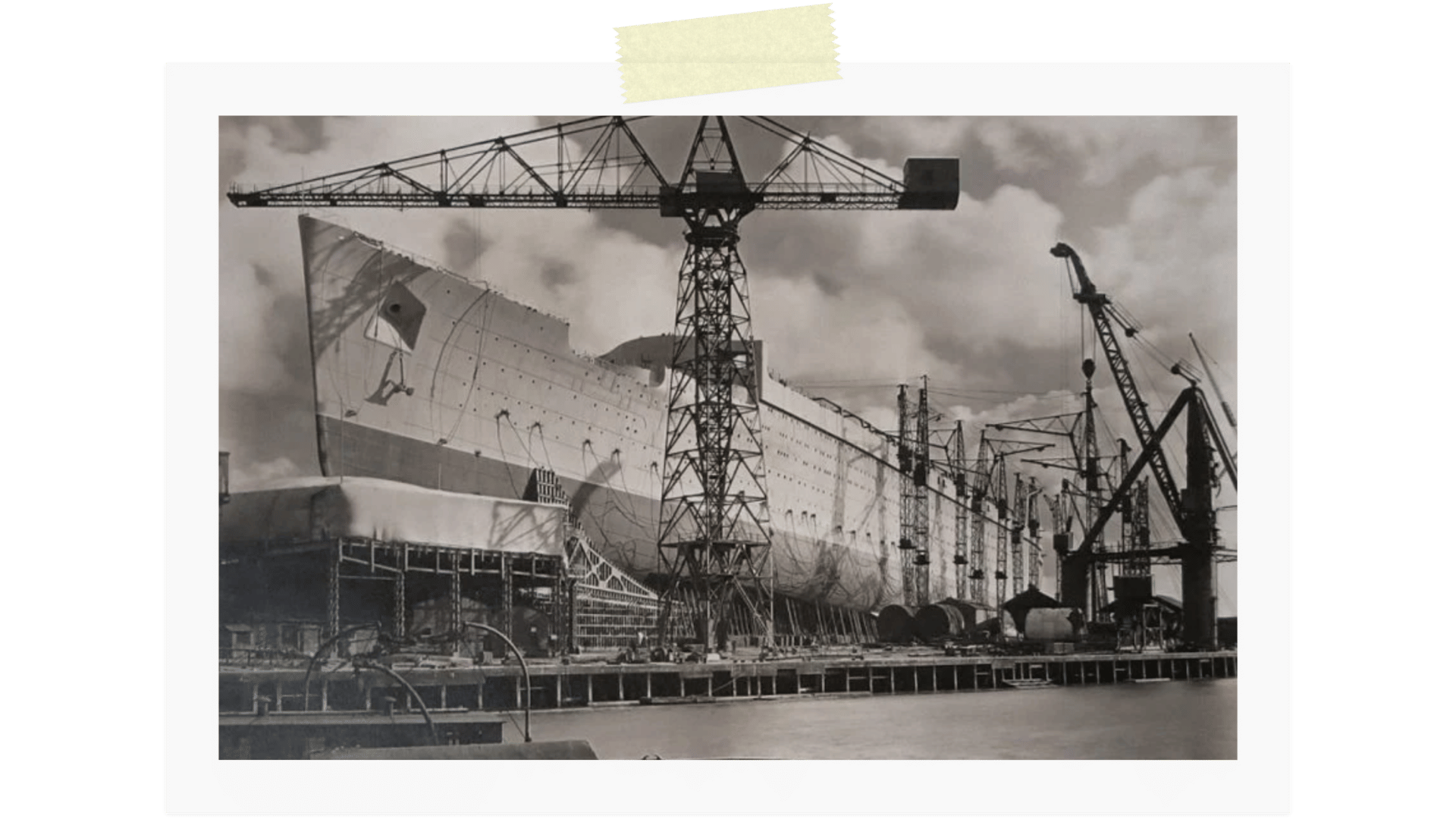
To talk about the countless hauntings reported in the Queen Mary, we must first dive into the rich history that surrounds this vessel. When the Queen Mary was first commissioned to be built, the world was a vastly different place.
Steel titans and shipping companies ruled the seas and waged war with one another, inside law and engineering offices of course. The 1930’s, were considered the golden age of the Ocean liner and this is evident in the amount of competition in the market.
Take a second and think about it, this is after the Titanic, people are still flocking to these massive ships simply because it was the only safe way to cross the ocean. All that flair and fancy of the Titanic hadn’t gone away either, and neither did the floating class system of the time.
These liners were essentially massive social experiments when it came to the diversification of different economic classes. You had the ultra-wealthy in first class art-deco suites and thousands of immigrants or lower-income travelers in the steerage, or third-class cabins; typically below deck.
With the popularity of these ships, comes a mudslide of technological advancements in sea-faring devices and vessels. The main goal of the competition between ship builders was speed. If you could get passengers across the Atlantic faster then the other guys, then your ship was the obvious choice.
An unofficial, yet prestigious title and award at this time was called the Blue Riband. It was given to the fastest passenger liner that set the record for the fastest average speed during a regular trans-Atlantic crossing. This was the best advertisement a company could have; travelers wanted to be on the fastest, most modern ship available. Just like today, minus the speed part.
Before the Queen Mary this title was held by two sister sips made in Germany. In 1929 and 1930, the Bremen and Europa passenger liners set sail on their maiden journeys. Each were awarded the Blue Riband at the time of their sailings.
This is specifically what led to two British companies, The White Star Line and Cunard, to create their own modern, and more importantly fast ocean liners.
The Great Depression Hits
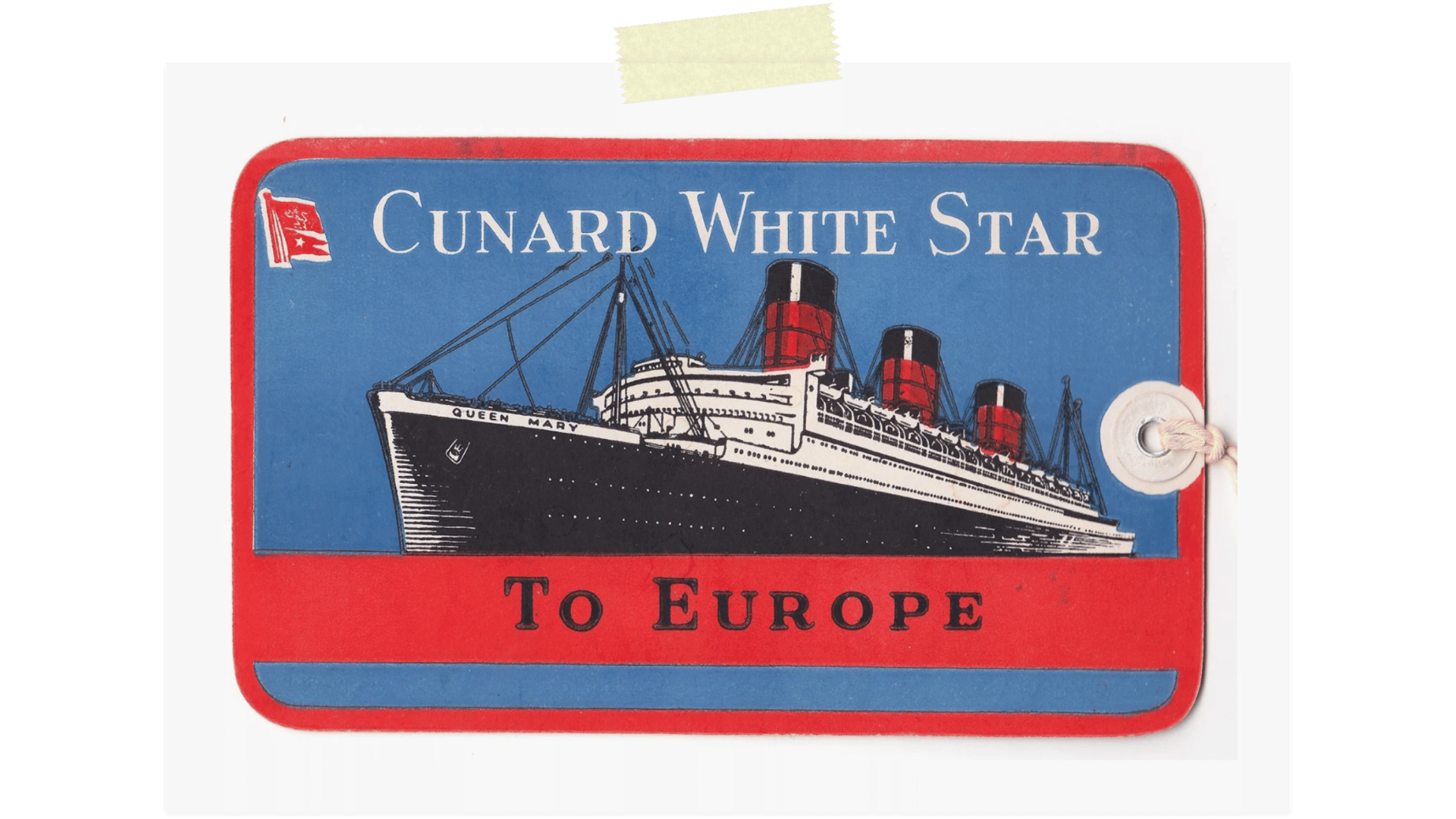
Well their plans got shut down quickly when the great depression hit and work halted on the Cunard ship, simply named at the time “Hull Number 534”. Around December 1931 Cunard applied to the British Government for a loan to complete 534, and the government said yes.
On one condition.
Cunard had to merge with the White Star line, which was also struggling at the time and had cancelled their planner liner, Oceanic at that time. Both lines agreed and on May 10th 1934, the Cunard-White Star Line was formed.
Work on 534 would begin immediately with a launch scheduled for fall 1934.
On September 26th 1934, her majesty Queen Mary launched the ship known still as hull 534 and named her RMS Queen Mary. The ship was so massive for the time that prior to the launch the Clyde River had to be deepened and widened to cope with the size.
Now, I don’t know how true this is, but there are claims that Cunard intended to launch the ship with the name “Victoria” which help up a tradition of naming their ships ending with a “ia”, but when the company reps asked king George if they could name the ship after Britain's “greatest queen”, he said his wife, Mary, would be delighted. So there's no going back at that point.
What's even funnier is there was already an old steamer ship names TS Queen Mary, so Cunard made an arrangement with it’s owners to have that older ship renamed to Queen Mary II. Which later would be the name given to the replacement for the RMS Queen Mary. Its all very confusing and kind of stupid.
Full Speed Ahead
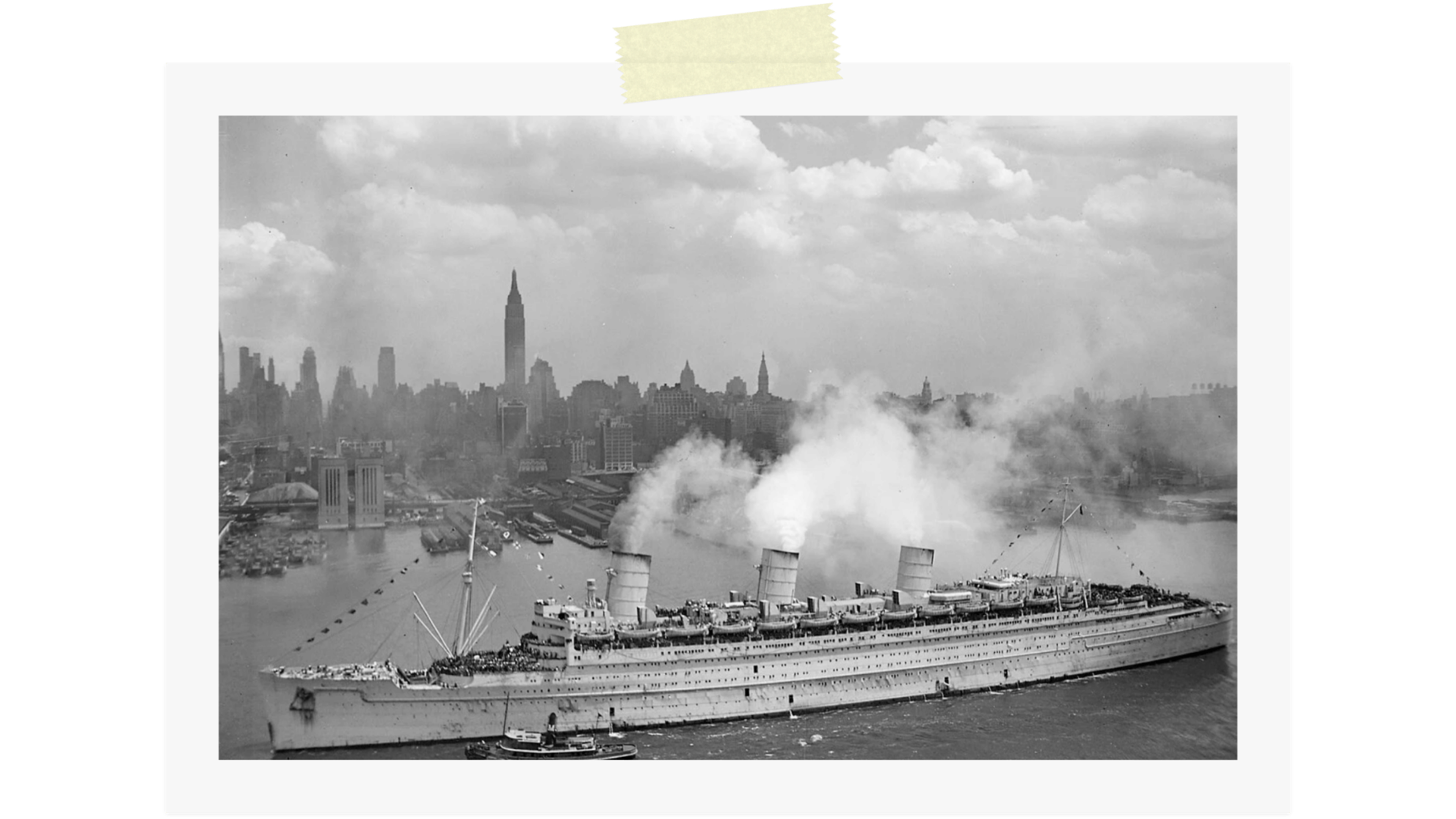
After the Launch the ship would continue to be worked on for another 2 years. On May 27th 1936, the Queen Mary sailed on her maiden voyage from Southampton to New York. She arrived in New York Harbor on June 1st 1936.
She wouldn’t capture the Blue Riband from the French ship the Normandie until August of that same year, where she was declared the fastest ocean liner in the business. The exact goal sought out by engineers nearly 6 years earlier.
After years of sailing a passenger ship, in late August 1939 the Queen Mary was return to southampton from New York when, due to fears of German U-boats and the brink of war, she was escorted by the military ship HMS Hood.
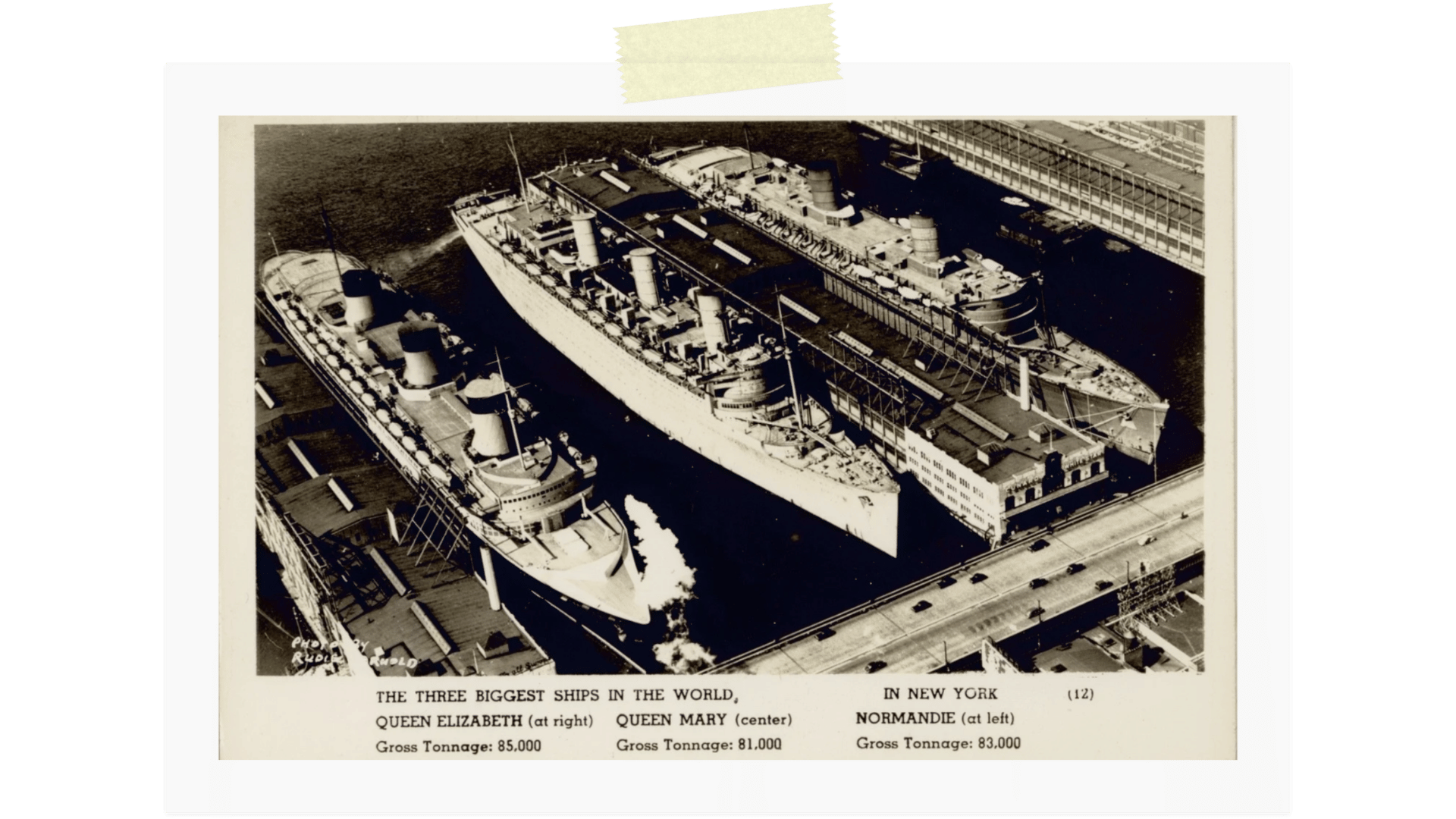
She set out again to New York on September 1st and by the time she arrived, war had been declared and she was ordered to remain in port alongside the same French ship she beat years earlier, the Normandie.
Eventually Queen Mary running mate, Queen Elizabeth would arrive and be ported in New York along side the other two vessels. For two weeks the three largest liners in the world sat idle.
The Grey Ghost Goes to War
When WWII broke out in 1939, the Queen Mary was stripped of her velvet curtains, fine china, and crystal chandeliers. Replaced by tiered wooden bunks and anti-aircraft guns, she was painted a stark naval grey, earning her the nickname the "Grey Ghost."
Her speed was her greatest weapon; she was so fast she could outrun Nazi U-boats, leading Adolf Hitler to famously offer a $250,000 bounty and the Iron Cross to any U-boat captain who could sink her. At her peak, she set a world record by carrying 16,082 American troops on a single voyage—a mass of humanity so dense that soldiers had to sleep in shifts.
The Curacoa Tragedy
The ship’s wartime service was legendary, but it was marred by a haunting tragedy in 1942. While zig-zagging to avoid torpedoes off the coast of Ireland, the Queen Mary accidentally collided with her own escort ship, the HMS Curacoa.
The massive liner sliced the smaller cruiser clean in half. Because of strict orders never to stop for fear of submarine attacks, the Queen Mary was forced to steam ahead, leaving over 300 men to drown in the icy Atlantic. To this day, many psychics and visitors claim the sounds of rushing water and metal tearing can still be heard in the extreme front of the ship’s hull.
Post-War Glory and the Jet Age
After the war, the ship was meticulously restored to her former Art Deco glory and returned to passenger service in 1947. For the next decade, she was the "it" ship for Hollywood royalty and heads of state. However, the 1950s brought a new predator: the jet engine.
As trans-Atlantic flights became faster and more affordable, the "Grand Dames" of the sea began to bleed money. By 1967, facing massive losses, the Cunard Line decided to retire the Queen Mary.
The Final Voyage to Long Beach
On October 31, 1967—fittingly, on Halloween—the Queen Mary departed Southampton for the last time. She embarked on a 39-day "Last Great Cruise" around Cape Horn, as she was too large to fit through the Panama Canal.
When she finally arrived in Long Beach, California, on December 9, she was greeted by a fleet of thousands of small boats and a DC-9 jet. Her boilers were shut down for the last time, ending an era of maritime history and beginning her second life as a permanent landmark—and, as many believe, a permanent home for the spirits that never checked out.
The Transition To Ghost Hotspot
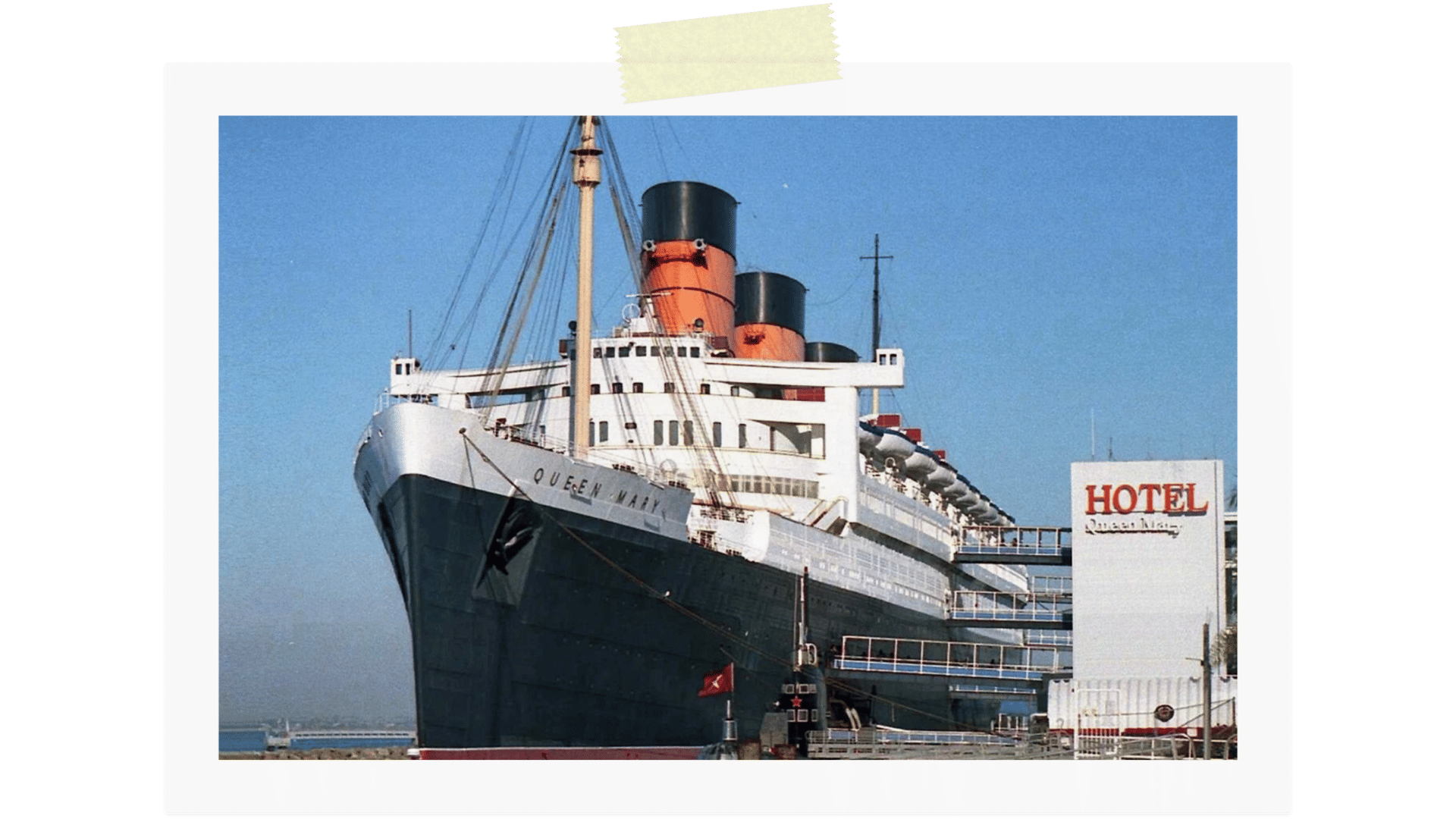
The transition from a record-breaking marvel of engineering to a permanent fixture of the Long Beach shoreline is where the Queen Mary’s history begins to bleed into the supernatural.
For over thirty years, she was a vessel of extreme human experience—from the opulent celebrations of the Hollywood elite to the cramped, grey-painted desperation of wartime troop transport. This dense accumulation of emotional energy, combined with the officially recorded tragedies of those who never made it to their destination, has left behind a "psychic wake" that many believe still ripples through the ship today.
As we move from the cold facts of the ship's logs into the darker corners of her hull, we find that the most enduring residents of the Queen Mary aren't the tourists in the staterooms, but the spirits tethered to the very moments that defined her legendary past.
The transition of the Queen Mary from a retired ocean liner to a world-renowned "haunted" destination didn't happen overnight; it was a slow burn of maritime rumors that exploded into the public consciousness through media coverage and a bit of corporate showmanship.
The Early Whispers (1967–1970s)
When the ship first arrived in Long Beach on December 9, 1967, it was celebrated as a historical monument, not a ghost ship. However, as soon as the massive vessel was opened for conversion into a hotel and museum, the stories began to leak out from the people who spent the most time in its belly: the night security guards and maintenance crews.
The First Reports: In the late 1960s, a security guard famously reported that his German Shepherd refused to enter "Shaft Alley" near Door 13, reacting to a presence that wasn't there.
The B340 Incident: In 1966, just before retirement, a female passenger in stateroom B340 reported a man standing at the foot of her bed who vanished into thin air. This became one of the first "civilian" accounts to gain internal traction among the crew.
The Psychic Spotlight (1980s)
The 1980s marked the era when the Queen Mary’s paranormal reputation went mainstream, largely thanks to the rise of televised paranormal investigations.
The Disney Era: In the 1980s, the ship was managed by the Disney Corporation. While historians note that some of the more "gory" legends (like the supposed triple murder in B340) may have been exaggerated by staff to drum up interest for a "Haunted Mansion" style experience, this marketing inadvertently solidified the ship’s status as a paranormal hotspot in the eyes of the public.
Famous Investigations: During this time, high-profile psychics—including Peter James, who spent years documenting the "residents" of the ship—began conducting public tours and séances. James is credited with "discovering" and naming many of the famous ghosts, such as Jackie in the pool and the Lady in White.
Media Explosion (1990s–Present)
By the 1990s, the Queen Mary had become a staple of paranormal pop culture.
National Television: The ship was featured on major programs like Unsolved Mysteries and Sightings, which brought the stories of John Pedder and Officer Stark to millions of viewers.
Ghost Hunters and Beyond: In the 2000s, the debut of Ghost Hunters (TAPS) and Ghost Adventures featured the ship in high-profile episodes, using modern technology like EMF meters and thermal cameras to "verify" the legends that had been told for decades.
Today, the hauntings are so central to the ship's identity that "Haunted Encounters" tours are among its most popular attractions, turning a century of tragedy into a permanent part of California folklore.
The Resident Ghosts
To understand why the ship remains so active, we have to look past the general "spookiness" and into the individual lives—and deaths—of the souls who are still reported to be walking her decks.
1. John Pedder: The Young Man of Door 13
The History: On July 10, 1966, 18-year-old crewman John Pedder (sometimes referred to as "Half-Hatch Harry") was working as a fireman/cleaner during a routine watertight door drill. He was caught and crushed by Watertight Door #13 in the engine room's "Shaft Alley" around 3:55 AM. He was found shortly after by a refrigeration greaser, with the only visible sign of trauma being a small amount of blood from his nose, though he had turned blue from lack of oxygen. He was pronounced dead upon arrival at the ship's hospital.
The Haunting: Pedder is one of the ship’s most frequently "seen" ghosts. Guests and guides report a young, bearded man in white boiler suits or blue overalls pacing the starboard side of Shaft Alley. He is often described as looking for a wrench—likely the one he used to manually operate the door that killed him. Some visitors have even reported finding greasy handprints near the door where he died.
2. William Eric Stark: The Poisoned Officer
The History: Born in 1918, William Eric Stark was a Senior Second Officer on the Queen Mary. On September 18, 1949, while the ship was in port, Stark was looking for a drink and was accidentally handed a gin bottle that had been used to store carbon tetrachloride, a toxic cleaning fluid. Thinking it was a gin and tonic, he took a drink. He initially laughed off the mistake, but the poison caused severe internal damage, and he died five days later on September 23, 1949, at the age of 30.
The Haunting: Stark’s spirit is said to maintain an "eternal watch" over the ship. He is most often reported in the Captain’s Quarters and on the bridge. Witnesses describe a heavy scent of cigar smoke or the sound of someone coughing and choking, believed to be an echo of his final painful days.
3. Jackie Torin: The Girl in the Pool
The History: While ship's logs are notoriously difficult to track for child passengers during the 1930s and 40s, legend states that a young girl named Jacqueline "Jackie" Torin drowned in the second-class swimming pool (now the site of the Royal Theater).
The Haunting: Jackie is described as an "intelligent haunting" because she appears to interact with investigators. For decades, guests have reported hearing a little girl’s giggling, singing, and splashing in the now-drained pool area. Some claim to see wet footprints appearing on the deck when no one is present, and paranormal teams have captured EVPs of a child's voice calling out for her parents.
4. Walter J. Adamson: The Resident of B340
The History: Stateroom B340 is the most notorious cabin on the ship. While many urban legends claim a triple murder occurred here in 1967, historical records confirm a passenger named Walter J. Adamson died in the room of natural causes in 1948.
The Haunting: Activity in B340 was so intense—including reports of water faucets turning on by themselves and bedcovers being ripped off guests—that the room was pulled from the hotel’s rental rotation for over 30 years. The first major report came in 1966 when a female guest woke up to a man staring at her; she screamed for security, but the man vanished before they arrived. This man is widely believed to be the spirit of Adamson.
5. The HMS Curacoa: The "Residual" Screams
The History: On October 2, 1942, during WWII, the Queen Mary was performing a "zigzag" maneuver to avoid U-boats when it accidentally collided with its escort, the HMS Curacoa. The massive liner sliced the smaller ship in half, and because of strict orders not to stop in submarine-infested waters, the Queen Mary left 338 men to drown in the Atlantic.
The Haunting: This is considered a "residual" haunting, meaning it's a psychic imprint of a past event rather than an interactive ghost. In the extreme front of the hull (the point of impact), visitors report hearing the sounds of rushing water, metal tearing, and the muffled screams of men in the distance.
6. Captain John Treasure Jones: The Eternal Captain
The History: Captain Jones was the man who commanded the Queen Mary on her final 1,000th crossing and her retirement voyage to Long Beach in 1967. He lived a long life after retirement and died in England in 1993 at age 87.
The Haunting: Though he did not die on the ship, many believe his "energy" returned to the vessel he loved most. Guests have reported seeing a man in a vintage Captain’s uniform in the elevators or on the bridge. He is often described as a calm, dignified presence who stares out at the Long Beach harbor as if still at the helm.
Conclusion
The RMS Queen Mary is a paradox: a monument to human achievement that became a mausoleum for human tragedy. She was the fastest thing on the Atlantic and a "Grey Ghost" of war, but with that much history packed into 1,000 feet of steel, the ship’s true weight isn’t measured in tons—it’s measured in the stories of those who never checked out.
Whether it’s the residual echoes of the 338 men lost with the HMS Curacoa, the tragic mistake of Officer Stark, or the lonely pacing of John Pedder, the Queen Mary serves as a permanent anchor for the past. Skeptics point to groaning pipes and infrasound, yet for those who have felt a tug on their sleeve or seen a vintage boiler suit vanish into a bulkhead, the ship is more than a hotel—it’s a glitch in time.
The mystery isn't just if she is haunted, but why these spirits remain. Perhaps the sheer volume of concentrated emotion—the fear of war and the shock of accident—burned a permanent imprint into the iron. The engines have long since gone cold, but the ship continues to hum with a different kind of energy. The Queen Mary was built to bridge two worlds across an ocean; now, she bridges the gap between the living and the dead. And as long as she remains afloat, the Grey Ghost will continue to be a place where history doesn’t just rest—it speaks.
About This Episode
This blog post is adapted from our Season 2 episode of the Mystery Date Podcast — “The RMS Queen Mary | The Most Haunted Cruise Ship”, part of our A Haunting season exploring the strange and mysterious side of the paranormal.
🎧 Listen to the full episode: Mystery Date Podcast
👕 Grab themed merch: Mystery and Co.
📬 Send us your local legends: mysterydatepodcast@gmail.com | (216) 770-4881